
The Income Tax Act, 2025 came into force on April 1, 2026, but that does not mean your 2026 ITR automatically comes under the new law.

If you are filing your AY 2026-27 income tax return, your return is still governed by the Income Tax Act, 1961.
Why? Because AY 2026-27 covers income earned during FY 2025-26 (April 1, 2025 to March 31, 2026). The new Income Tax Act 2025 applies to income earned from April 1, 2026 onward, which is called Tax Year 2026-27 under the new system.
So, you do not need to file two returns in 2026.
Quick answer: Does the Income Tax Act 2025 apply to your ITR 2026?
Not if you’re filing the return for AY 2026-27. Your AY 2026-27 ITR covers income earned during FY 2025-26, so it continues to be governed by the Income tax Act, 1961. The Income tax Act 2025 applies to income earned from April 1, 2026, referred to as Tax Year 2026-27 under the new Act.
| Income earned during | Return terminology | Governing law |
| FY 2025-26 | AY 2026-27 | Income-tax Act, 1961 |
| FY 2026-27 | Tax Year 2026-27 | Income Tax Act, 2025 |
The Income Tax Department has confirmed this directly: even though the filing typically happens after 1 April 2026, the AY 2026-27 return relates to a pre-transition year and stays under the old Act.
What is the ITR deadline in 2026?
The deadline depends on the type of taxpayer.
| Taxpayer category | AY 2026-27 due date |
| ITR-1 / ITR-2 taxpayers | July 31, 2026 |
| Eligible non-audit business/professional taxpayers | August 31, 2026 |
| Tax-audit cases | October 31, 2026 |
| Transfer-pricing cases | November 30, 2026 |
As of now, the July 31 deadline has passed. Eligible non-audit business and professional taxpayers generally have until August 31, 2026.
The Income Tax Department’s current communications also confirm August 31, 2026 as the AY 2026-27 filing deadline for taxpayers covered by that extension.
Always check the e-filing portal for any subsequent extension before filing.
What about tax-audit cases?
Taxpayers whose accounts require a tax audit under the Income-tax Act, 1961 follow a separate, later timeline, the tax-audit return deadline for AY 2026-27 falls on October 31, 2026, and transfer-pricing cases on November 30, 2026. We cover audit timelines separately.
| Taxpayer category | AY 2026-27 deadline |
| ITR-1 / ITR-2 category | July 31, 2026 |
| Eligible non-audit business/profession cases (ITR-3 / ITR-4) | August 31, 2026 |
| Tax-audit cases | October 31, 2026 |
| Transfer-pricing cases | November 30, 2026 |
Deadlines can be extended by the CBDT. Always confirm the current date on the e-filing portal before you file, as these are subject to change.
Why are there two different names, AY 2026-27 and Tax Year 2026-27?
This distinction lies at the core of the transition.
Under the Income-tax Act, 1961, income was earned in the Previous Year (PY) and assessed in the subsequent Assessment Year (AY). Thus, income earned in FY 2025-26 is reported in AY 2026-27.
The Income Tax Act, 2025 simplifies this framework by replacing both terms with a single Tax Year. From April 1, 2026, income earned during FY 2026-27 will fall under Tax Year 2026-27 and be reported in 2027.
The distinction matters: AY 2026-27 relates to income earned in FY 2025-26 under the 1961 Act, while Tax Year 2026-27 relates to income earned in FY 2026-27 under the 2025 Act.
Income Tax Act 1961 vs Income Tax Act 2025: what changes?
You do not need to learn the entire new Act to file this year’s return. Here are the changes that matter for someone thinking about their ITR.
| Feature | Income-tax Act, 1961 | Income Tax Act, 2025 |
| Year terminology | Previous Year + Assessment Year | Tax Year |
| Current relevance | AY 2026-27 and earlier applicable years | Tax Year 2026-27 onward |
| Return framework | Existing ITR framework (Section 139) | New Act framework (Section 263) |
| Transition | Continues for earlier tax years | Applies to new tax years |
| Portal | Existing e-filing system | Portal supports both during transition |
The Income Tax Department has confirmed that the e-filing portal will facilitate compliance under both Acts during the transition, in practice, the portal now shows two tabs, one for each Act.
Need help with filing taxes? Get in touch with us to help with your process.
What does the Income Tax Act 2025 actually change for taxpayers?

“Tax Year” replaces the old year terminology
The new Act replaces the “Previous Year” and “Assessment Year” system with a single “Tax Year”, aligned with the year in which the income is earned.
Assessment Year is discontinued under the new Act
The Assessment Year concept is discontinued under the 2025 Act. However, “AY” still applies to returns governed by the 1961 Act, including AY 2026-27.
Return-filing provisions are consolidated
Under the new Act, return-filing provisions are consolidated under Section 263, covering original, belated, revised and updated returns. This broadly replaces Section 139 under the 1961 Act.
The broad filing obligation remains similar
The new Act reorganises and renumbers tax provisions, but the broad rules on who needs to file and when remain largely similar.
The new tax regime continues
The new tax regime continues under Section 202 of the 2025 Act, replacing Section 115BAC of the 1961 Act. The broad regime structure remains unchanged.
What does NOT change for your AY 2026-27 ITR?
This is the part to hold on to. For your 2026 return, you still use:
- The assessment year AY 2026-27
- Income earned during FY 2025-26
- The applicable old-law ITR forms (ITR-1 to ITR-7 under the 1961 Act)
- The Income-tax Act, 1961 framework, including familiar references like Sections 80C, 80D, 24(b) and 87A
The Income Tax Department has explicitly stated that AY 2026-27 returns continue under the old Act, including revised returns and related proceedings, even when filed after April 1, 2026.
The fact that you are filing after April 1, 2026 does not automatically move your AY 2026-27 return into the new Act.
What changes for income you earn from April 1, 2026?
Income earned between April 1, 2026 and March 31, 2027 falls under Tax Year 2026-27 and the Income Tax Act, 2025. Its return will be filed in 2027, after the tax year ends.
For the transition year, there is no double filing: AY 2026-27 covers FY 2025-26 under the 1961 Act, while Tax Year 2026-27 covers FY 2026-27 under the 2025 Act.
What should you do before the 2026 ITR deadline?
A practical run-through:
- Identify your income year. Is this return for FY 2025-26? If yes, you are in the AY 2026-27 cycle.
- Select the correct assessment year. For FY 2025-26 income, choose AY 2026-27 on the portal (the Income-tax Act, 1961 tab).
- Check your applicable deadline. Do not assume everyone has the same date, confirm whether July 31, August 31 or an audit date applies to you.
- Select the correct ITR form. This matters most for business owners, professionals, freelancers and investors. The AY 2026-27 ITR utilities (ITR-1 to ITR-4, and others) are available on the e-filing portal.
- Reconcile AIS and Form 26AS. Cross-check the income and tax credits shown against your own records before filing.
- Check TDS/TCS. Make sure the tax already deducted or collected is correctly reflected.
- Review capital gains. Particularly on equity, mutual funds and other investments, since the FY 2024-25 capital gains changes apply in full this year.
- Check your tax regime selection. If you have business or professional income and want the old regime, Form 10-IEA within the due date is generally required.
- Pay any remaining tax. Clear any self-assessment tax due before filing to limit interest.
- Verify the return. A return not e-verified within 30 days of filing is treated as not filed, Aadhaar OTP is the quickest route.
ITR deadline 2026 for different types of taxpayers
Salaried taxpayers
Generally ITR-1 or ITR-2, with a July 31, 2026 due date. If you missed it, the belated route applies.
Freelancers and professionals
Typically ITR-3 or ITR-4. Eligible non-audit cases have until August 31, 2026.
Business owners
Non-audit businesses filing ITR-3/ITR-4 have the August 31, 2026 date; businesses requiring a tax audit follow the October 31, 2026 timeline.
Investors with capital gains
Usually ITR-2 (or ITR-3 if you also have business income), with the July 31 or August 31 date depending on your profile. Review your capital gains statements carefully before filing.
Tax-audit cases
A separate, later deadline of October 31, 2026 for AY 2026-27, with transfer-pricing cases on November 30, 2026.
Trusts
The applicable date depends on whether the trust’s accounts require audit and on the specific provisions that apply to it, so trusts should confirm their exact due date rather than assume a single date.
Snazzy Wealth’s tax and accounting solutions cover both Individual Tax and Corporate Tax, and Individual and Corporate Accounting, useful if your situation spans more than one of the categories above.
What happens if you miss the ITR deadline?
Missing the due date does not close the door, but it comes at a cost.
You can file a belated return for AY 2026-27 until December 31, 2026, with a late fee of up to ₹5,000 and interest on unpaid tax. Certain losses may also become ineligible for carry-forward. A revised return can be filed later within the prescribed timeline.
Can I file after August 31, 2026? Yes, but filing on time is cheaper.
Common confusions about the Income Tax Act 2025
“The new Act started on April 1, so my AY 2026-27 ITR must use it.” No. AY 2026-27 covers FY 2025-26 income and stays under the Income-tax Act, 1961, even when filed after April 1, 2026.
“AY 2026-27 and Tax Year 2026-27 are the same.” No. AY 2026-27 is FY 2025-26 income under the old Act. Tax Year 2026-27 is FY 2026-27 income under the new Act, filed in 2027.
“I need to file two returns because two Acts are operating.” No. You file one return for FY 2025-26 now, and the Tax Year 2026-27 return later, in 2027. They are separate obligations for separate periods.
“The August 31 deadline applies to everyone.” No. August 31 is for eligible non-audit business/professional (ITR-3/ITR-4) filers. ITR-1/ITR-2 filers had July 31, and audit cases have later dates.
“The new Act changes the tax treatment of everything immediately.” Not simply by virtue of filing your AY 2026-27 return. That return uses the old Act’s framework; the new Act’s provisions apply to income from April 1, 2026 onward.
Income Tax Act 2025 transition timeline
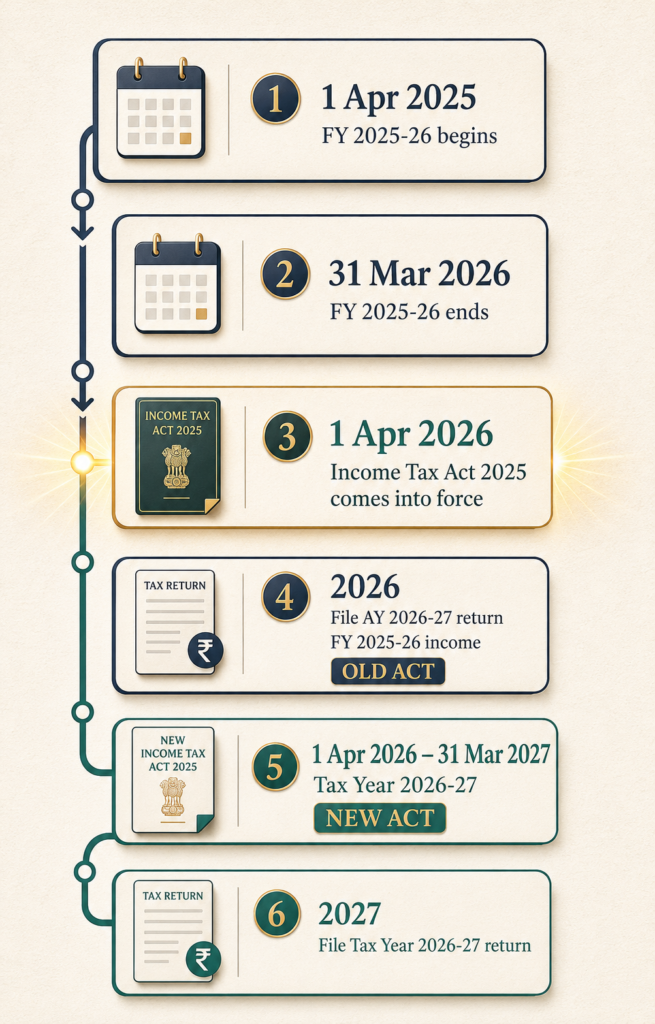
The official transition guidance makes exactly this distinction: the year you file in and the year your return relates to are two different things.
Conclusion
The biggest takeaway from the 2026 tax transition is that the date you file your return and the tax year it relates to are two different things. If you are filing your AY 2026-27 ITR for income earned during FY 2025-26, the Income-tax Act, 1961 continues to govern that return. The Income Tax Act 2025 applies to income earned from April 1, 2026 onward, under Tax Year 2026-27.
Before filing, check your applicable deadline, choose the correct ITR form, reconcile your income and tax information (AIS and Form 26AS), and make sure you are selecting the correct assessment year, AY 2026-27, on the e-filing portal.
Need help with individual or business tax compliance? Explore Snazzy Wealth’s tax and accounting solutions.
Frequently Asked Questions
Q: What is the last date to file ITR in 2026?
A: For AY 2026-27, July 31, 2026 for ITR-1/ITR-2 filers and August 31, 2026 for eligible non-audit ITR-3/ITR-4 filers; tax-audit cases have October 31, 2026. The CBDT can extend these dates, so verify on the portal.
Q: Does the Income Tax Act 2025 apply to AY 2026-27?
A: No. AY 2026-27 relates to FY 2025-26 income and is governed by the Income-tax Act, 1961, even if you file after April 1, 2026.
Q: What is the difference between AY 2026-27 and Tax Year 2026-27?
A: AY 2026-27 is FY 2025-26 income under the old Act. Tax Year 2026-27 is FY 2026-27 income under the new Act, filed in 2027.
Q: Which Act applies to income earned in FY 2025-26?
A: The Income-tax Act, 1961. That income is filed as the AY 2026-27 return.
Q: When does the Income Tax Act 2025 apply?
A: To income earned from April 1, 2026 onward (Tax Year 2026-27). The Act came into force on April 1, 2026.
Q: Do I need to file two income tax returns during the transition?
A: No. You file your AY 2026-27 return for FY 2025-26 income now, and your Tax Year 2026-27 return later, in 2027. They are separate obligations.
Q: What is the ITR deadline for business owners in 2026?
A: For non-audit businesses (ITR-3/ITR-4), August 31, 2026. Businesses requiring a tax audit follow October 31, 2026.
Q: What is the ITR deadline for salaried individuals in 2026?
A: July 31, 2026 for AY 2026-27 (ITR-1/ITR-2). If missed, you can file a belated return up to December 31, 2026, with a late fee and interest.
Q: Can I file my ITR after the deadline?
A: Yes, as a belated return up to December 31, 2026, with a late fee of up to ₹5,000 under Section 234F and interest under Section 234A on any unpaid tax.
Q: Will I use the new ITR forms for AY 2026-27?
A: No. AY 2026-27 uses the old Act’s ITR forms. The new ITR forms under the Income Tax Act, 2025 apply from Tax Year 2026-27 and will be used in 2027.
Sources: Income Tax Department – Income Tax Returns (transition FAQ), incometax.gov.in. This article is for educational and general information purposes only. It reflects publicly available information as of the date of publication and is not tax, legal or financial advice. Due dates, fees and provisions can change, and the CBDT may extend deadlines; please verify the current position on the official e-filing portal and consult a qualified tax professional for your specific situation.