
The RBI’s Monetary Policy Committee raised the repo rate by 25 basis points to 5.50% on October 7, 2026, the first hike in nearly four years. For most investors, the right response is not to stop SIPs or make drastic portfolio changes.
The bigger questions are about your debt-fund duration, how much rate-sensitivity is already in your portfolio, and whether your asset allocation still aligns with your goals. One rate hike is not a reason to act in panic. It is a reason to review with clarity.

RBI Repo Rate Hike at a Glance
| Parameter | October 2026 |
| Previous repo rate | 5.25% |
| New repo rate | 5.50% |
| Change | +25 basis points |
| Vote | Unanimous |
| Last hike | February 2023 |
| Policy stance | Calibrated tightening |
| CPI inflation forecast (FY27) | 5.2% |
| GDP growth forecast (FY27) | 7.1% |
| Key concern | Rising inflation, global tensions, volatile crude prices |
Governor Sanjay Malhotra stated that rate cuts are “off the table in the near term”, the next move will be either another hike or a pause.
How Does a Repo Rate Hike Affect Mutual Funds?
The transmission mechanism works like this:
Repo rate ↑ → borrowing costs and yields ↑ → bond prices ↓ → debt-fund NAVs can face short-term pressure
Higher rates make newly issued bonds more attractive. Older bonds with lower coupons fall in price to compensate. Funds holding those older bonds see their NAVs marked down accordingly. The longer the duration of the fund, the greater the sensitivity.
Impact on Debt Mutual Funds
Debt funds are directly in the line of fire when rates rise, but the degree of impact varies considerably by category.
Interest-rate risk and duration risk are two sides of the same problem. Duration measures how sensitive a bond’s price is to interest rate changes.
A fund with a 5-year average duration will fall roughly 5% in price for every 1% rise in yield. A fund with a 1-year duration will fall roughly 1% for the same yield move.
Mark-to-market impact is immediate. When yields rise, the NAVs of debt funds reflect that fall in bond prices in real time. This is not a permanent loss, if you hold the bond to maturity, you receive the full principal back. But in the short term, NAVs can and do fall.
What this means in practice: The current rate environment strongly favours shorter-to-medium duration funds. Longer-duration funds carry more risk when yields are rising, and the RBI’s forward guidance (“another hike or a pause”) suggests yields could stay elevated for some time.
Need help with understanding mutual funds? Get in touch with us at Snazzy Wealth to get started.
Impact on Equity Mutual Funds
Rate hikes affect equity markets through several channels.
Higher borrowing costs raise the cost of capital for businesses. Companies that are heavily leveraged, borrowing to fund operations or expansion, face higher interest expenses, which can compress earnings. This shows up in earnings estimates over time, not immediately.
Valuation compression is the more immediate concern. Equity valuations are partly determined by discounting future cash flows. When interest rates rise, the discount rate rises too, which reduces the present value of future earnings. This is one reason rate-sensitive sectors tend to underperform in rising-rate environments.
Rate-sensitive sectors include real estate, infrastructure, capital-intensive manufacturing, and NBFCs. Banking can go either way, higher rates can improve net interest margins but also raise credit risk if borrowers struggle.
None of this means equity mutual funds should be sold. A rate hike is not a signal to exit equities. Equity returns are driven more by earnings growth, valuations, and time horizon than by any single rate move. The RBI itself projects 7.1% GDP growth for FY27, a strong economic backdrop for earnings.
Impact on Hybrid and Multi-Asset Funds
Hybrid and multi-asset funds offer a middle ground that becomes more relevant in a rate-transition environment.
When equity volatility picks up and debt yields become more attractive simultaneously, as they may in the current cycle, funds that can hold both benefit from the diversification. An investor who is uncertain about making an all-or-nothing call between equity and debt may find hybrid or multi-asset allocation funds easier to hold through a period of policy transition.
Balanced advantage funds and dynamic asset allocation funds actively adjust their equity-debt mix based on market conditions, which can provide some natural buffer during volatility.
Should You Stop Your SIP After the RBI Rate Hike?
Generally, no, not solely because of a 25 bps repo rate hike.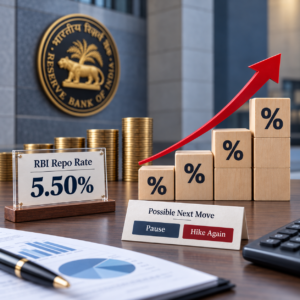
SIPs are most effective precisely when markets are uncertain. Stopping a SIP during volatility defeats the purpose of rupee-cost averaging, which works by purchasing more units when prices are lower.
If you have a long-term SIP: Continue in line with your goal and asset allocation. The RBI changes rates multiple times over the life of a long-term investment. Attempting to time every policy decision is not a viable strategy.
If you have a large lump sum to deploy: Consider staggering the deployment rather than investing the full amount immediately. If market volatility or rate uncertainty concerns you, deploying in tranches over 3–6 months through a Systematic Transfer Plan (STP) from a liquid fund is a reasonable approach.
If your goal is less than 3 years away: This is the situation where the rate hike conversation does matter most. Reassess your equity exposure. If a market drawdown would delay your goal, capital preservation should take priority. Reducing equity allocation and shifting toward shorter-duration debt may be appropriate, not because of the rate hike per se, but because the goal horizon doesn’t allow time for recovery.
Which Debt Mutual Funds Could Make Sense After a Rate Hike?
These are category-level considerations, not specific fund recommendations. The right choice depends on your investment horizon, risk tolerance, and existing portfolio.
| Fund category | Rate-hike environment | Suitable consideration |
| Liquid funds | Minimal duration sensitivity | Very short-term needs (up to 3 months) |
| Ultra short / low duration | Lower interest-rate sensitivity | Short horizons (3–12 months) |
| Short duration | Potentially attractive | Moderate horizon (1–3 years) |
| Corporate bond | Quality credit + moderate duration | Investors seeking relatively stable debt exposure |
| Gilt funds | Higher interest-rate sensitivity | Experienced investors with appropriate longer horizon |
| Long-duration funds | Higher volatility when yields rise | Only with a suitable horizon and clear risk tolerance |
Current market thinking is strongly tilted toward shorter-to-medium duration and quality credit. Funds that hold shorter-maturity bonds are less exposed to price falls when yields rise. Longer-duration bets are not off the table permanently, if the rate cycle peaks and eventually reverses, longer-duration funds stand to benefit, but right now, the direction of rates is not clearly down.
On credit quality: In a rising-rate environment, credit risk tends to increase. Companies under financial stress face higher borrowing costs. Chasing higher yield through lower-quality credit is not the right trade-off at this point. Prefer quality over yield.
What About Equity Mutual Funds After the Repo Rate Hike?
Large-cap funds are better suited as a core equity allocation during periods of uncertainty. Large companies generally have more financial resilience, greater access to capital markets, and more diversified revenue streams than smaller companies. In a rate-tightening cycle, that financial strength matters.
Mid- and small-cap funds should not be panic-sold purely because of the rate hike. If you have a long time horizon and the funds are part of a considered allocation, a rate hike alone is not a sufficient reason to exit. That said, mid and small caps tend to be more sensitive to economic conditions and cost of capital, review your concentration and whether valuations still justify the allocation.
Sectoral and thematic funds carry higher concentration risk. If you hold a sector that is particularly rate-sensitive, real estate, infrastructure, highly leveraged companies, it is worth reviewing whether that exposure is sized appropriately. Avoid making tactical sector bets based on a single rate decision without understanding the underlying sector dynamics.
The broader point on equity: the RBI’s own GDP projection of 7.1% for FY27 suggests a fundamentally strong economy. A rate hike designed to control inflation, in an economy growing at 7%, is not the same as a recession signal.
Should You Move From Equity Mutual Funds to Debt Funds?
Not automatically. The right allocation between equity and debt depends on your investment horizon, financial goal, risk tolerance, and existing asset allocation, not simply on the current repo rate.
If you are a long-term investor (7+ years to goal): Stay aligned with your equity allocation. Equity has historically delivered returns above inflation over long periods. One rate-hike cycle does not change that fundamental case.
If you have a short or medium-term goal (1–5 years): Reassess how much equity risk is appropriate. If you cannot afford a significant drawdown without delaying the goal, a shift toward capital-preservation-oriented debt is worth considering, but for goal-timing reasons, not rate-panic reasons.
If you are a conservative investor: Review whether your current debt allocation and its duration profile still match your risk appetite. Shifting to shorter-duration debt may reduce volatility in your portfolio without requiring a significant asset allocation change.
Want to know more about other mutual funds? Read our post on direct and regular mutual funds for more insights.
What Should Mutual Fund Investors Do Now?
This is the right question. Here is a structured checklist.
- Continue SIPs for long-term goals. Do not stop SIPs because of a rate hike. Stay invested.
- Do not panic-sell equity funds. Volatility is normal during rate transitions. Your time horizon matters more than the current rate.
- Review your debt-fund duration. If you hold long-duration debt funds, assess whether you are comfortable with the duration risk in a rising-rate environment.
- Prefer credit quality over yield-chasing. In a tightening cycle, higher-quality debt holdings are more appropriate.
- Stagger large lump-sum investments if appropriate. If you have a significant amount to deploy and are concerned about near-term volatility, deploying in tranches reduces timing risk.
- Review your asset allocation. A rate hike is a reasonable prompt to check whether your equity-debt split still matches your goals and risk tolerance, not to change it in panic, but to confirm it is still right.
- Match debt-fund duration with your investment horizon. If your horizon is 1 year, a long-duration fund is not appropriate regardless of the rate environment.
- Avoid trying to predict the rate peak. Nobody knows whether this is the last hike or the first of several. Position your portfolio for the range of outcomes, not a single prediction.
- Review portfolio concentration. Rate-sensitive sectors and asset classes deserve a second look, not necessarily to exit, but to confirm the sizing is appropriate.
- Rebalance based on goals, not headlines. If your portfolio has drifted significantly from your target allocation due to market movements, now is a reasonable time to rebalance. But the driver should be your goal-based allocation, not the rate hike news.
What If RBI Hikes Rates Again?
Governor Malhotra was clear: the next move will be “either a hike or a pause.” Rate cuts are off the table in the near term. That means investors should be prepared for three possible scenarios.
Scenario A: This is a one-off hike, and RBI pauses
If inflation moderates and global conditions stabilise, the RBI may pause here. In this case, the market impact on debt and equity is likely to be limited. Short-to-medium duration debt performs adequately, and equity markets may stabilise.
Scenario B: Gradual tightening cycle
If inflation remains elevated, driven by food prices, energy costs, and global spillovers, the RBI hikes again in the December or February meeting. Short-duration and quality-credit debt continues to outperform longer-duration alternatives. Equity markets may see more volatility, particularly in rate-sensitive sectors.
Scenario C: Rates eventually peak and decline
At some point in this cycle, the rate trajectory will turn. When it does, longer-duration debt could become significantly more attractive as bond prices rise. Equity markets have historically responded positively to the beginning of a rate-cut cycle. Investors who have been holding shorter-duration debt for safety can begin extending duration once the peak is clearer, but there is no need to try to perfectly time that transition.
The future path, as Governor Malhotra stated, “is contingent on actual growth and inflation developments and outlook.” The key variables to watch are CPI inflation (currently forecast at 5.2% for FY27), crude oil prices, the global rate environment, and monsoon and food price dynamics.
RBI Repo Rate Hike: Investor Decision Matrix
| Investor situation | What to consider |
| Long-term SIP investor | Continue SIP; avoid panic decisions |
| Large lump-sum investor | Consider staggered deployment via STP |
| Short-term debt investor | Prefer lower-duration categories |
| Existing long-duration debt investor | Review duration risk; assess whether comfortable holding through potential further hikes |
| Conservative investor | Review debt allocation and credit quality; consider shorter duration |
| Equity-heavy investor | Check diversification; review rate-sensitive sector exposure |
| Nearing a financial goal | Reduce unnecessary portfolio volatility; reassess equity exposure |
| Retirement / SWP investor | Review withdrawal sustainability; ensure debt allocation is appropriately duration-matched |
Conclusion
The RBI’s 5.5% repo rate is a reason to review your portfolio thoughtfully, not to panic about it.
The right response is to continue SIP discipline for long-term goals, review debt-fund duration and credit quality, prefer shorter-to-medium duration debt in this environment, confirm your asset allocation still matches your goals, and avoid making investment decisions based on rate headlines rather than personal financial circumstances.
If you are unsure whether your mutual fund allocation matches your goals, risk profile, and investment horizon, consider reviewing your portfolio with an AMFI-registered mutual fund distributor.
Frequently Asked Questions
Q: What happens to mutual funds when RBI increases the repo rate?
A: Higher repo rates push up borrowing costs and bond yields. Rising yields push down bond prices, so debt funds with longer duration see NAV pressure in the short term. Equity funds can face valuation headwinds as the discount rate for future earnings rises. Hybrid funds and diversified portfolios experience a blended impact.
Q: Is a repo rate hike good or bad for debt mutual funds?
A: It depends on the type and duration of the fund. Longer-duration debt funds face more short-term NAV pressure. Shorter-duration funds are more insulated. Over time, rising yields mean reinvestments happen at higher rates, which can benefit shorter-duration funds. The impact is not uniformly “bad”, it depends on what you own and for how long.
Q: Should I stop my SIP after the RBI repo rate hike?
A: Generally, no. SIPs are long-term instruments. Stopping a SIP during market uncertainty removes the benefit of rupee-cost averaging. Unless your financial goal, horizon, or risk tolerance has fundamentally changed, continuing the SIP is the right default.
Q: Which debt mutual funds are suitable when interest rates rise?
A: Shorter-duration categories, liquid funds, ultra short / low-duration funds, and short-duration funds, tend to be more resilient in a rising-rate environment. Corporate bond funds with quality credit also hold up better than longer-duration or lower-quality alternatives.
Q: Are long-duration debt funds risky after a repo rate hike?
A: Yes, more so than usual. Long-duration funds are significantly more sensitive to yield movements. In a rising-rate environment, their NAVs can fall meaningfully. They are not necessarily wrong for every investor, but they require a longer time horizon and a clear understanding of the duration risk.
Q: Should I switch from equity mutual funds to debt funds?
A: Not automatically. The right equity-debt split depends on your goals, horizon, and risk tolerance, not the current rate. If you are a long-term investor, your equity allocation should be driven by your goal timeline, not by a rate decision. If you are close to your goal, reducing equity exposure may be appropriate, but for horizon reasons, not rate-panic reasons.
Q: Will RBI rate hikes affect SIP returns?
A: In the short term, rate hikes can create volatility in both equity and debt markets, which may affect unit prices during the SIP period. Over a longer horizon, the impact smooths out. For SIPs in equity funds, short-term NAV dips during a rate-hike period can actually be beneficial, you purchase more units at lower prices.
Q: Should I invest a lump sum after the repo rate hike?
A: If you have a long time horizon and a clear goal, investing is still appropriate. If you are concerned about near-term volatility, staggering the deployment through an STP over 3–6 months can reduce timing risk. Do not let rate uncertainty lead to indefinite delay, time in the market generally matters more than timing the market.
Q: What happens to bond prices when interest rates rise?
A: Bond prices and yields move in opposite directions. When yields rise, existing bonds with lower fixed coupons become less attractive, so their prices fall to make the effective yield match the market rate. This is the inverse relationship that drives NAV movements in debt mutual funds.
Q: What should mutual fund investors do if RBI hikes rates again?
A: Review your debt duration and confirm it matches your horizon. Continue long-term SIPs. Avoid making concentrated bets on a specific rate path. If further hikes occur, shorter-duration debt continues to be more insulated. If the cycle peaks and eventually reverses, longer-duration debt may become more attractive, but there is no need to anticipate that prematurely.
This article is for educational and general information purposes only. It is not investment, financial, legal, or tax advice. Mutual fund investments are subject to market risks. Past performance is not indicative of future results. Please read all scheme-related documents carefully before investing. Tax rules may change, verify current rates with a qualified tax professional. Snazzy Wealth Private Limited (ARN-259333) is an AMFI-registered Mutual Fund Distributor.