SEBI’s proposed SME IPO rule changes could lower the minimum application amount, revise company eligibility requirements, and change how SME-listed shares are traded. However, the proposals are not yet final rules, they are a consultation paper published on 14 October 2026, with public comments open until 4 November 2026. Investors should understand both the potential implications and the underlying investment risks before making any decisions.
Why Is SEBI Proposing New SME IPO Rules?
India’s SME IPO segment has grown significantly over the past few years. More companies are listing, more retail investors are participating, and the scale of some SME issues has begun to approach what was traditionally the territory of the main board.
With that growth has come greater scrutiny. Concerns about promoter conduct, post-listing price manipulation, grey-market speculation, and the suitability of SME IPOs for retail investors have all surfaced in market commentary and regulatory discussion.
SEBI’s October 2026 consultation paper proposes a significant overhaul: higher eligibility requirements, a market-cap-based framework to determine where a company should list, changes to the minimum application size and number of allottees, and structural changes to how SME stocks are traded and what shareholders can do with their shares post-listing.
The stated objective is to improve investor protection while making the SME listing framework more proportionate to company size and market conditions.
What Are the Proposed SME IPO Rule Changes in 2026?
| Parameter | Existing framework | SEBI’s proposal |
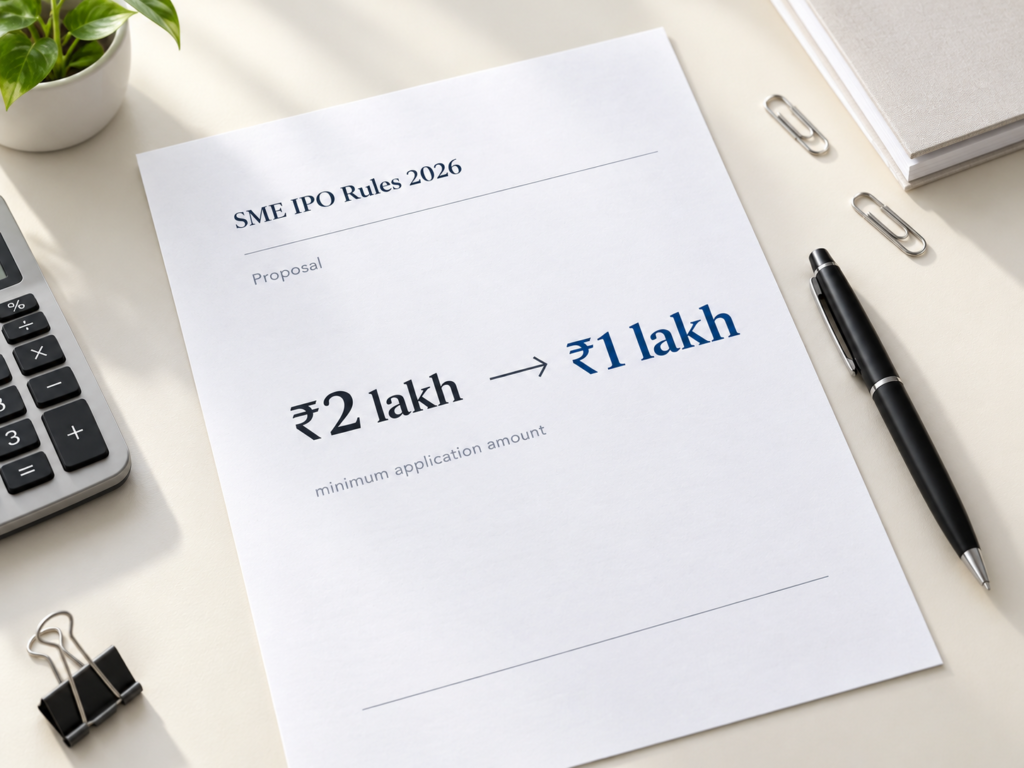
| Minimum application value | ₹2 lakh | ₹1 lakh (4 lots of at least ₹25,000 each) |
| Minimum number of allottees | 200 | 500 |
| Company eligibility | Paid-up-capital-based criteria | Market-capitalisation-based thresholds |
| Operating profit requirement | At least ₹1 crore in 2 of preceding 3 years | Average operating profit of at least ₹3 crore per year over preceding 3 years |
| Alternative eligibility route | None | Book-built issue with at least 75% QIB allocation; full refund if threshold not met |
| SME trading lot | Price-band-based lot size | Proposed reduction to 1 share |
| Compulsory market making | Required for 3 years | Proposed removal |
| Underwriting | 100% underwriting; lead manager takes 15% on own account | SME-specific requirements removed; aligned with main board; 90% minimum subscription |
| Promoter lock-in (minimum contribution) | 3 years | 3 years from IPO allotment (unchanged) |
| Promoter lock-in (excess above minimum) | 50% for 2 years, rest for 1 year | 1 year (simplified) |
| Pre-IPO holders (non-promoter) | 1 year | 6 months |
| OFS rules | No dedicated OFS rule for SMEs | Seller must hold shares 1 year before filing DRHP; OFS capped at 20% of issue size; each seller capped at 50% of pre-issue holding |
| General corporate purpose cap | 15% of issue or ₹10 crore, whichever is lower | 15% of issue (₹10 crore ceiling removed) |
| Public comment deadline | — | 4 November 2026 |
Note: These are proposals, not final rules. The ICDR Regulations, 2018 remain unchanged until SEBI notifies formal amendments.
How Could the New SME IPO Eligibility Criteria Work?
Market-capitalisation-based eligibility
The proposed framework replaces paid-up capital tests with post-issue market capitalisation thresholds:
Up to ₹1,000 crore post-issue market cap: The company would list on the SME platform only.
₹1,000 crore to ₹4,000 crore post-issue market cap: The company would have the option to choose between the SME platform and the main board. Companies in this range that have not yet adopted Ind AS would be required to prepare restated consolidated financial statements under applicable accounting standards.
Above ₹4,000 crore post-issue market cap: Main-board listing would be required. Companies at this scale would not be eligible for the SME platform under the proposed framework.
This is a meaningful structural shift. Currently, whether a company goes to the SME platform or the main board is primarily determined by paid-up capital. The proposed market-cap framework attempts to align the listing venue with the actual scale of the company.
Higher operating-profit threshold
The current profitability test requires at least ₹1 crore in operating profit in at least 2 of the 3 financial years preceding the IPO application.
The proposed threshold is significantly higher: an average operating profit of at least ₹3 crore per year over the preceding 3 financial years. This would screen out companies with thin or inconsistent profitability at a higher level than the current framework.
Alternative route for companies that don’t meet the profit test
Companies that cannot meet the proposed average operating-profit threshold would not be automatically excluded under SEBI’s proposal. An alternative route would be available: a book-built issue in which at least 75% of the net offer is allocated to qualified institutional buyers (QIBs).
If the required QIB allocation is not achieved, the issuer would be required to refund all application amounts. The QIB portion under this route would not be underwritten.
This route acknowledges that some companies, particularly in early-growth sectors, may not yet meet a profit threshold while still having a legitimate case for public capital. But it channels those issues toward institutional investors rather than retail-heavy participation, which is a meaningful distinction.
The key takeaway: The proposals would change how eligible companies qualify for an SME IPO, but eligibility under the regulatory framework does not substitute for assessing business quality, financial statements, and disclosures. A company that qualifies is not automatically a good investment.
Interested in investing in equity? Call us at Snazzy Wealth to get started.
What Does the Proposed ₹1 Lakh Minimum Application Mean for Retail Investors?
Under the current framework, the minimum application in an SME IPO is ₹2 lakh. SEBI has proposed reducing this to ₹1 lakh, structured as 4 lots, each with a minimum value of ₹25,000.
Will the minimum SME IPO investment become ₹1 lakh?
SEBI has proposed reducing the minimum SME IPO application value from ₹2 lakh to ₹1 lakh. The proposal is not yet final. Investors should not assume the lower limit is already in force.
What this means in practice:
Under the current framework, applying to an SME IPO requires a minimum capital commitment of ₹2 lakh per application. Under the proposal, that threshold would fall to ₹1 lakh.
| Current minimum | Proposed minimum | |
| Application amount | ₹2 lakh | ₹1 lakh |
| Structure | Lot-size based | 4 lots × ₹25,000 minimum each |
| Capital committed per application | ₹2 lakh | ₹1 lakh |
A lower minimum makes SME IPO participation accessible to investors who could not previously meet the ₹2 lakh threshold. More investors will be able to apply without deploying as much capital in a single issue.
What it does not change is the underlying business, its valuation, its liquidity post-listing, or the risks that come with investing in smaller, developing companies. Lower entry cost does not mean lower risk. SME IPOs can see sharp post-listing price movements, both up and down, and secondary-market liquidity in SME stocks is often limited or uneven. These characteristics do not change because the minimum application amount is reduced.
How Could the Proposed 500-Allottee Rule Affect SME IPOs?
The minimum number of allottees for a successful SME public issue would increase from 200 to 500 under the proposal.
The intention is to ensure wider distribution of shares among investors at the time of listing. A higher minimum allottee count means that more distinct investors hold shares from the outset, which in principle reduces concentration, where a small number of allottees hold a disproportionate share of the issue.
From an investor-protection perspective, wider distribution at listing can make it more difficult for a small group of shareholders to influence the post-listing price. It also means the company’s shareholder base is broader from day one.
What it does not guarantee: A higher number of allottees does not automatically indicate stronger demand, better post-listing performance, or greater long-term liquidity. Allottee count is a minimum participation threshold, not a measure of investor conviction or fundamental value.
The allocation process for SME IPOs would also need to accommodate the higher minimum. The practical implications for how retail applications are processed will become clearer when SEBI publishes its final framework.
What Other SME IPO Rules Could Change?
SME stock trading lots
Currently, SME stocks trade in price-band-based lots that can require a substantial minimum investment to buy in the secondary market. SEBI has proposed reducing the trading lot to 1 share, pending a separate circular rescinding the existing lot-size framework.
If implemented, this would allow investors to buy and sell SME stocks in smaller quantities in the secondary market, rather than having to purchase an entire lot. The potential benefit is greater flexibility for investors who want to add to or reduce their positions without committing to a full lot.
This does not guarantee better liquidity, tighter bid-ask spreads, or more active trading. Liquidity in SME stocks depends on trading volumes and the number of active buyers and sellers, not only on lot size.
Compulsory market making
Under the current framework, SME-listed companies are required to have a market maker for 3 years post-listing. The market maker’s role is to provide two-way quotes, buy and sell prices, to support trading in the stock.
SEBI has proposed removing the compulsory market-making requirement. Current arrangements would continue until a fresh circular is issued.
The investor consideration: Market making provides a baseline of liquidity in SME stocks, particularly in the early months of listing when trading may be thin. Removing the requirement does not automatically improve or worsen liquidity, the market itself may provide adequate two-way interest for some stocks and very little for others. Investors should factor in liquidity risk when considering SME stocks, particularly in the absence of a mandated market maker.
Promoter and pre-IPO shareholder lock-ins
Lock-in rules govern how long certain shareholders must hold their shares before they are eligible to sell after an IPO.
Proposed changes:
- Promoter minimum contribution: 3 years from IPO allotment (unchanged from current framework)
- Promoter holdings above the minimum contribution: 1 year (simplified from the current tiered structure of 50% for 2 years and the rest for 1 year)
- Pre-IPO holders who are not promoters: reduced from 1 year to 6 months
Lock-in periods matter to investors because they affect when existing shareholders may become eligible to sell large blocks of shares. A shorter lock-in for non-promoter pre-IPO holders means that certain early investors could become eligible to sell sooner after listing. The actual impact depends on market conditions, the specific shareholders’ intentions, and applicable rules at the time.
IPO proceeds and offer-for-sale rules

OFS restrictions: SEBI has proposed dedicated OFS rules for SME issues. Under the proposal, a selling shareholder must have held shares for at least 1 year before filing the Draft Red Herring Prospectus. OFS would be capped at 20% of the total issue size, and each individual seller would be capped at 50% of their pre-issue holding. QIB sellers would generally be exempt from these caps, except under the alternative QIB-allocation route.
These restrictions are designed to reduce situations where promoters or early investors use the IPO primarily to exit their holdings rather than raise fresh capital for the company.
General corporate purpose: The current cap on using IPO proceeds for general corporate purposes is 15% of the issue or ₹10 crore, whichever is lower. The proposal removes the ₹10 crore ceiling, allowing companies to use up to 15% of the issue for general corporate purposes regardless of issue size.
Will SEBI’s Proposed SME IPO Changes Make SME IPOs Safer?
The balanced answer: The proposals aim to strengthen regulatory safeguards and revise the SME IPO framework. They cannot eliminate the investment risks associated with smaller, developing companies.
Regulatory eligibility and investment quality are different things. A company can be fully compliant with every applicable SEBI requirement while still being a poor investment, overvalued relative to its earnings, operating in a weak competitive position, carrying significant debt, or having promoters with a track record that warrants scrutiny.
Does a SEBI-compliant SME IPO mean the investment is safe?
No. Regulatory compliance is important. It means the company has met the minimum requirements to access public markets and has made the disclosures SEBI requires. It does not guarantee business success, fair valuation, post-listing liquidity, or positive investment returns.
Before investing in any SME IPO, examine:
- Revenue and profit consistency across financial years, not just the most recent year
- Operating cash flow versus reported earnings, profitability on paper can diverge from actual cash generation
- Debt levels and interest-coverage, can the business service its obligations?
- Promoter background and shareholding, review disclosures, related entities, and any past regulatory actions
- Related-party transactions, what proportion of revenue or procurement runs through related entities?
- IPO valuation compared with comparable listed businesses, is the issue price justified by the financial performance?
- Stated use of IPO proceeds, is the capital going into business growth or primarily to existing shareholders?
- Customer and supplier concentration, heavy dependence on a few customers or suppliers is a business risk
- Post-listing liquidity, SME stocks can see wide bid-ask spreads and thin trading, which makes it difficult to exit at a reasonable price
Higher eligibility standards reduce the number of weaker issuers reaching the market, but they do not remove the need for individual assessment of every SME IPO.
SME IPOs vs Mainboard IPOs: What’s the Difference?
| Factor | SME IPO | Mainboard IPO |
| Typical issuer profile | Smaller, developing businesses | Generally larger, more established businesses |
| Listing platform | SME platform (BSE SME or NSE Emerge) | BSE or NSE main board |
| Eligibility | SME-specific regulatory framework | Mainboard eligibility framework |
| Minimum application | Currently ₹2 lakh (₹1 lakh proposed) | ₹15,000 (subject to applicable rules) |
| Liquidity | Can be limited or uneven; lot-based trading currently | Varies; many mainboard stocks have broader participation |
| Financial track record | Requires careful assessment | Requires careful assessment |
| Regulatory disclosure burden | Lighter than main board | More extensive |
| Investor risk | Can involve significant business, valuation and liquidity risks | Also involves market and company-specific risks |
Company size alone does not determine the risk of an investment. Mainboard companies can be poor investments; some SME-listed companies have strong fundamentals. The relevant question is always whether the specific company’s business quality, valuation, and risk profile justify the investment, not whether it is on the SME platform or the main board.
What Should Investors Do Before Applying for an SME IPO?
- Read the DRHP and RHP The Draft Red Herring Prospectus and Red Herring Prospectus contain the company’s business description, audited financials, risk factors, and the stated use of IPO proceeds. These are not optional reading, they are the primary source of information about the investment.
- Check profitability and cash flow Look beyond revenue growth and headline profit figures. Examine whether operating cash flow supports reported earnings, how margins have moved over time, and whether recent profitability reflects genuine business performance or temporary factors.
- Evaluate the valuation Compare the issue price against the company’s financial performance, earnings, cash flow, and net worth. Then compare the implied valuation with comparable listed businesses. A lower-priced issue is not automatically a better-valued one.
- Investigate promoter history Review promoter disclosures in the prospectus. Check for any regulatory actions, prior business failures, or related-party arrangements that affect how you assess the promoters’ credibility and track record.
- Understand the allotment and trading rules Confirm the rules actually in force at the time of application. Proposed changes are not yet effective, the current framework applies until SEBI notifies the final amendments.
- Assess liquidity Consider whether you could exit at a reasonable price if you needed to sell. SME stocks can have thin secondary-market trading even after listing. If you may need to sell within a defined timeframe, illiquidity is a material risk.
- Avoid grey-market premium hype Informal grey-market premiums reflect speculative demand before listing and are not a reliable indicator of post-listing performance, fundamental value, or allotment probability. They have been wrong in both directions, stocks trading at significant GMP have listed below issue price, and vice versa.
- Limit concentration Avoid allocating a disproportionate share of your portfolio to any single SME IPO, or to the SME IPO category as a whole. The risk profile of smaller, less-established companies justifies sizing positions carefully relative to your overall portfolio.
When Will the New SME IPO Rules Come Into Effect?
SEBI published the consultation paper on 14 October 2026. The public-comment period closes on 4 November 2026.
After the comment period, SEBI will review submissions and decide whether to adopt the proposals as drafted, modify them, or set them aside. The final rules, if adopted, will be implemented through amendments to the ICDR Regulations, 2018, notified in the Official Gazette. Only on that notification do the new rules take legal effect.
There is no confirmed implementation date at this point. Until SEBI publishes its final decision and any implementation timelines, the existing SME IPO framework continues to apply.
Investors and issuers should monitor SEBI’s official communications at sebi.gov.in for the final outcome.
Conclusion
SEBI’s proposed SME IPO reforms could meaningfully reshape how smaller companies access public markets and how investors participate in SME issues. A lower minimum application, higher allottee requirements, market-cap-based eligibility, and revised lock-in and OFS rules all represent substantive changes to the framework if they are adopted.
But none of these proposed changes reduce the fundamental requirement to assess an SME IPO based on its own merits. Lower entry requirements are not lower risk. A higher eligibility bar does not validate the business or the valuation. Regulatory safeguards matter, and they are one input among several, not a substitute for reading the prospectus, understanding the financials, and evaluating whether the investment makes sense for your portfolio.
Before making equity investment decisions, understand the company’s fundamentals, the risks involved, and how the investment fits into your broader portfolio.
FAQs
Q: What are the new SME IPO rules proposed by SEBI in 2026?
A: SEBI’s October 14 consultation paper proposes reducing the minimum application from ₹2 lakh to ₹1 lakh (structured as 4 lots of at least ₹25,000), increasing minimum allottees from 200 to 500, replacing paid-up-capital eligibility criteria with market-cap thresholds, raising the operating profit requirement, reducing trading lots to 1 share, removing compulsory market making, and tightening OFS and lock-in rules. These are proposals, not final rules.
Q: Will the minimum SME IPO application amount be reduced to ₹1 lakh?
A: SEBI has proposed reducing it from ₹2 lakh to ₹1 lakh. The proposal is open for public comment until 4 November 2026 and is not yet final. The current minimum of ₹2 lakh remains in force until SEBI formally notifies the amended rules.
Q: What is the proposed minimum number of allottees for an SME IPO?
A: SEBI has proposed increasing the minimum from 200 to 500 allottees. A higher allottee count would distribute shares more widely at listing and reduce concentration among a small number of shareholders.
Q: What is the proposed profit requirement for SME IPO eligibility?
A: The proposed threshold is an average operating profit of at least ₹3 crore per year over the 3 financial years preceding the IPO application. This replaces the current requirement of at least ₹1 crore in operating profit in at least 2 of the preceding 3 years.
Q: What happens if a company does not meet SEBI’s proposed SME IPO profit criteria?
A: An alternative route would be available: a book-built issue in which at least 75% of the net offer is allocated to qualified institutional buyers. If the QIB allocation threshold is not achieved, the issuer must refund all application amounts. The QIB portion under this route would not be underwritten.
Q: What market-capitalisation limits has SEBI proposed for SME IPOs?
A: Post-issue market cap up to ₹1,000 crore: SME platform only. Between ₹1,000 crore and ₹4,000 crore: the company can choose between the SME platform and the main board. Above ₹4,000 crore: main-board listing required.
Q: Will SME stocks be tradable in single-share lots?
A: SEBI has proposed reducing the trading lot to 1 share. The change would take effect through a separate circular rescinding the existing lot-size framework. The proposal is not yet final.
Q: Will the new SME IPO rules make SME investments safer?
A: The proposals aim to raise the bar for eligibility and strengthen certain investor protections. However, regulatory compliance does not eliminate investment risk. Business risk, valuation risk, and liquidity risk are not removed by SEBI tightening the framework. Investors still need to assess each SME IPO on its own merits.
Q: What is the difference between SME IPOs and mainboard IPOs?
A: SME IPOs list on the SME platform (BSE SME or NSE Emerge) and typically involve smaller, developing companies. Mainboard IPOs list on the main board and generally involve larger, more established companies with more extensive disclosure requirements. Minimum application sizes, lot structures, and typical liquidity differ. Both carry investment risk that requires individual assessment.
Q: When will SEBI’s proposed SME IPO rules become effective?
A: The consultation paper is not itself a rule change. SEBI will review public comments received by 4 November 2026 before deciding on the final framework. The rules take effect only on formal notification in the Official Gazette. No confirmed implementation date has been announced.
This article is for educational and general information purposes only. It is not investment, legal, or regulatory advice. The SEBI proposals discussed are from the consultation paper dated 14 October 2026 and are subject to revision or withdrawal following the public-comment process. The existing SEBI (ICDR) Regulations, 2018 remain in force until formally amended. Verify the current applicable rules on SEBI’s official website (sebi.gov.in) before making investment or compliance decisions. Snazzy Wealth Private Limited (ARN-259333) is an AMFI-registered Mutual Fund Distributor.