
Most people pick health insurance the wrong way. They compare premiums, pick the highest sum insured they can afford, and assume the job is done.
The problem is that the premium and the sum insured headline are the least important numbers in the policy. The numbers that determine how much you actually receive at claim time, room-rent limits, co-payments, sub-limits, waiting periods, exclusions, are buried in the policy wording, rarely discussed in the sales conversation, and misunderstood by most buyers until they are sitting in a hospital trying to file a claim.
A ₹20 lakh policy with restrictive sub-limits, a 20% co-payment clause, and a room-rent cap of ₹3,000/day may deliver less real protection than a well-structured ₹10–15 lakh policy with no co-pay and no room-rent limit. The numbers on the brochure and the numbers that show up at claim settlement are not always the same.
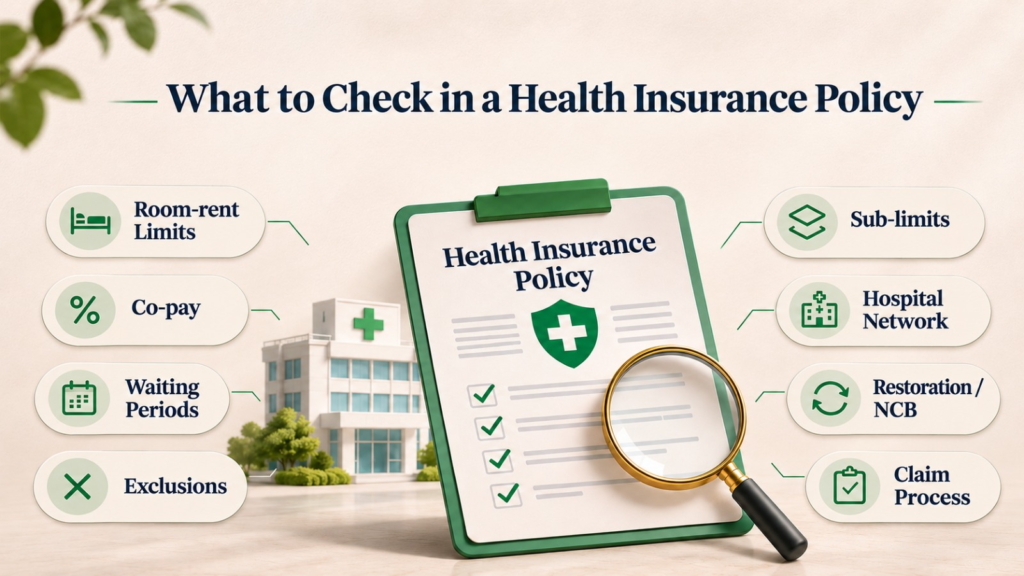
Before buying, evaluate all of these:
- Sum insured and actual coverage scope
- Hospital network (and your hospital’s presence in it)
- Room-rent limits
- Exclusions, what the policy explicitly does not cover
- Pre-existing disease (PED) waiting period
- Specific disease and procedure waiting periods
- Co-payment and deductibles
- Sub-limits on specific treatments
- Restoration and No-Claim Bonus (NCB) benefits
- Claim process and insurer servicing quality
This article walks through each of these, so you can evaluate a policy on what actually matters.
If you are exploring health coverage as part of your broader financial protection plan, you can also learn about Snazzy Wealth’s health insurance solutions.
How Much Health Insurance Coverage Do You Need?
There is no single correct number, but there is a sensible way to think about it.
The practical floor for most urban families today is ₹10–15 lakh per individual. Metro cities like Mumbai, Delhi, Bengaluru, and Chennai have seen hospital costs rise sharply, a week in a private hospital ICU can easily consume ₹5–10 lakh. A serious illness requiring surgery and extended stay can breach ₹15–20 lakh even before add-ons like ICU upgrades or specialist consultations.
Individual policy vs family floater
An individual policy covers one person for the full sum insured. A family floater pools the sum insured across all covered members, which means one hospitalisation that exhausts the pool leaves others exposed within the same year.
Floaters are cost-efficient for young families with low concurrent hospitalisation risk. They become problematic when:
- A member has a chronic or recurring condition
- The age gap between the oldest and youngest member is large (premiums for floaters are priced on the oldest member)
- Multiple members need hospitalisation in the same policy year
On parents: Adding parents to a family floater is rarely the right call. Senior citizens have higher hospitalisation risk, their inclusion raises the entire floater premium dramatically, and many policies come with co-payment clauses specific to older members. A separate senior citizen health policy, evaluated independently, is usually a more sensible structure.
A practical framework:
|
Situation |
What to focus on |
|
Young individual |
Adequate base cover, upgradeability as income grows |
|
Young couple |
Individual vs floater cost-benefit for 2 people |
|
Family with children |
Floater with restoration benefit to handle multiple claims |
|
Parents / senior citizens |
Separate cover, check co-pay clauses and PED waiting period |
|
Metro-city household |
Higher sum insured to reflect actual hospitalisation costs |
|
Employee with employer cover |
Independent policy, employer cover ends when the job does |
The most important point about employer-provided cover: it disappears when you change jobs, lose your job, or retire. And starting a fresh individual policy at 45 or 50 means fresh waiting periods at the age when you are most likely to need the cover. Building your own policy early is structurally smarter than relying entirely on employer cover.
What Does a Health Insurance Policy Actually Cover?
Understanding the structure of what a policy covers, before you look at what it excludes, is the starting point.
Core hospitalisation coverage (standard across most policies):
- In-patient hospitalisation, admission for 24 hours or more
- Day-care procedures, medical procedures that require less than 24 hours but are medically necessary (cataract surgery, chemotherapy, dialysis, and others listed in the policy)
- Pre-hospitalisation expenses, typically doctor consultations, diagnostics and medicines for a specified period before admission (commonly 30–60 days, depending on the policy)
- Post-hospitalisation expenses, follow-up consultations, medicines and diagnostics for a specified period after discharge (commonly 60–90 days)
- Ambulance costs, subject to applicable limits in the policy
- ICU charges, typically covered, though some older policies had ICU-specific sub-limits
Additional benefits (varies by policy, not universal):
- Maternity cover, usually requires a separate waiting period of 2–3 years from policy inception
- New born cover, often attached to maternity benefits
- OPD (Outpatient Department) cover, consultations and medicines without hospitalisation; available in some comprehensive plans, often as an add-on
- AYUSH treatment, Ayurveda, Yoga, Unani, Siddha, Homoeopathy, where included
- Mental healthcare, IRDAI regulations require coverage for mental health conditions on par with physical conditions; policy scope varies
- Domiciliary / home healthcare, treatment at home in lieu of hospitalisation, where the policy permits
- Organ donor expenses, treatment costs for the donor in a transplant, where covered
The critical phrase here: Depending on the policy and applicable terms. Do not assume a benefit is included because a competitor’s policy or a friend’s policy had it. Read the policy wording or the Key Features document for the specific plan you are evaluating.
Don’t Just Look at the Sum Insured: Check These Coverage Restrictions
This is where the real comparison happens, and where most buyers fail to do the work.
Room-rent limits
Room-rent limits are one of the most consequential, and least understood, restrictions in health insurance in India.
Here is how they work:
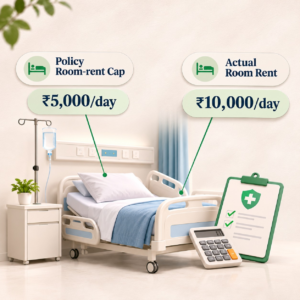
If a policy says room rent is capped at ₹5,000/day, and the hospital bills ₹10,000/day for the room, you are not simply paying the ₹5,000 difference in room cost. Many policies apply a proportionate deduction to the entire hospital bill based on the room-rent overrun.
A simplified example:
- Sum insured: ₹10 lakh
- Policy room-rent cap: ₹5,000/day
- Room actually occupied: ₹10,000/day (200% of the limit)
- Hospital bill: ₹4 lakh (including all medical expenses)
- Depending on policy wording, the insurer may apply proportionate deduction, meaning the admissible claim could be significantly lower than ₹4 lakh even though the total bill is well within the ₹10 lakh sum insured
The proportionate deduction logic varies by insurer and policy wording. Some policies apply it to the entire medical bill. Some apply it only to associated charges. This distinction matters enormously.
Policies with “no room-rent limit” or “room as per sum insured” remove this risk entirely. They typically carry a higher premium, but the premium difference is often worth understanding in the context of what the room-rent cap can cost you at claim time.
What to check: Whether the policy has a room-rent limit, what that limit is, and whether the deduction on excess room charges is proportionate (applied to associated expenses) or only on the differential.
Disease-specific sub-limits
A sub-limit is a cap on what the insurer will pay for a specific procedure or condition, regardless of the overall sum insured.
Classic examples: cataract surgery may be capped at ₹30,000–₹50,000. Certain joint replacement procedures may have a defined ceiling. Specific surgeries or treatments listed in the policy schedule may carry their own limits.
This means a ₹10 lakh policy can still pay only ₹40,000 for a cataract operation that costs ₹70,000, if the sub-limit says ₹40,000. The sum insured is irrelevant to the sub-limited procedure.
Newer, more comprehensive policies are increasingly offered without sub-limits. Older or entry-level plans are more likely to carry them. Check the policy schedule or ask the insurer specifically about sub-limits on common procedures.
Co-payment
Co-payment (co-pay) means you bear a defined percentage of every admissible claim amount, out of pocket.
If your policy has a 20% co-pay and your admissible claim is ₹5 lakh, you pay ₹1 lakh and the insurer pays ₹4 lakh. Every time. Regardless of the reason for hospitalisation.
Co-pay clauses are common in:
- Policies covering senior citizens
- Policies covering specific conditions or treatments
- Policies available for residents of specific cities or hospital types
- Some group health policies
Co-pay ≠ deductible ≠ sub-limit, these are distinct things:
- Co-payment, you pay a percentage of every admissible claim
- Deductible, a fixed amount per claim or per year that must be exceeded before the insurer pays anything
- Sub-limit, a cap on what the insurer pays for a specific procedure, regardless of everything else
Understanding which of these applies to a policy, and in what combination, is essential before comparing two plans.
Deductible
A deductible is a threshold. The insurer does not pay anything until the claim exceeds the deductible.
Per-claim deductible: Each individual claim must exceed the deductible amount before the insurer pays. If the deductible is ₹25,000 and the claim is ₹20,000, you bear the full ₹20,000.
Aggregate deductible: The deductible applies across all claims in a policy year. Once total claims in the year exceed the aggregate deductible, the insurer covers the remainder. This structure is common in super top-up policies.
Base policy + super top-up: A common arrangement is a base policy (say ₹5–10 lakh) paired with a super top-up (say ₹50 lakh with a ₹10 lakh annual deductible). The super top-up pays once the year’s total hospitalisation expenses exceed the deductible, which the base policy is intended to cover. This can significantly increase the total protected amount at a lower combined premium than a single ₹60 lakh base policy.
The mechanics matter: the base policy and super top-up must be understood together, not evaluated in isolation.
Health Insurance Exclusions: What the Policy Will Not Cover
Exclusions are the conditions, treatments and expenses the policy will not pay for, and reading them is not optional if you want to know what you are actually buying.
Common exclusions to check:
- Cosmetic, aesthetic and reconstructive procedures (unless required following an accident or illness)
- Non-medical expenses, toiletries, attendant charges, administrative fees, items listed in IRDAI’s non-admissible expense list
- Dental treatment, routine dental is typically excluded; policies vary on whether dental treatment following an accident is covered
- Spectacles, hearing aids and contact lenses, generally excluded from standard health policies
- Treatment arising from substance abuse or self-inflicted conditions
- Experimental or unproven treatments
- OPD expenses, unless specifically covered in the plan
- Specific listed procedures or conditions during waiting periods
- Conditions not disclosed accurately at the time of policy purchase, which is both an exclusion and a claims dispute risk
The most important thing about exclusions: They differ between policies. An exclusion that applies in one insurer’s standard policy may be absent in another’s. Never assume one policy’s exclusion list is industry-standard. Read the exclusions in the specific plan you are evaluating.
Exclusions are also a common source of claim disputes. Reading the exclusions section before buying, not after a claim is rejected, is the only way to avoid this.
Waiting Periods: The Clause That Catches Most Buyers Off Guard
Waiting periods are the intervals after policy inception during which specific conditions or treatments are not covered. They exist in every health insurance policy and differ across policy types and insurers.
|
Waiting period type |
What it means |
|
Initial waiting period |
Most new policies exclude illness-related hospitalisation for a defined initial period (often 30 days) from policy start. Accidents are typically covered from day one. |
|
Pre-existing disease (PED) waiting period |
Conditions you had before buying the policy are covered only after a specified waiting period from inception. Under IRDAI’s (Insurance Products) Regulations, 2024 (effective April 1, 2024), the maximum PED waiting period any insurer can apply is 3 years, reduced from the earlier 4-year cap. Individual insurers may offer shorter PED waiting periods. |
|
Specific disease / procedure waiting period |
Named conditions or procedures carry their own waiting period, separate from the PED period. These vary by insurer and product. |
|
Maternity waiting period |
If the policy includes maternity benefits, a separate waiting period, commonly 2–3 years, applies before maternity claims are admissible. |
What is the 60-month moratorium period?
Under the applicable IRDAI framework, after 60 continuous months of coverage, a health insurance policy and claim generally cannot be contested on grounds of non-disclosure or misrepresentation, except in cases of established fraud. If the sum insured is enhanced, the moratorium period applies separately to the enhanced portion. This does not remove the importance of disclosing medical history accurately when purchasing a policy.
On pre-existing diseases, why disclosure matters:
A PED is a condition for which you have sought treatment, been diagnosed, or had symptoms before the policy start date. The specific definition and applicable window vary by insurer and policy wording.
Failing to disclose a PED accurately at the time of purchase creates a risk of claim rejection, not just for PED-related hospitalisation, but potentially for related or consequential conditions. The waiting period is designed to be served, not avoided. Accurate disclosure means you know exactly when your existing conditions will be covered. Non-disclosure means the insurer may deny claims on those grounds.
If you have a pre-existing condition and are comparing policies, one of the most practical things to do is compare PED waiting periods across plans, a 1-year PED waiting period from an insurer willing to cover the condition is significantly more useful than a 3-year wait.
Cashless vs Reimbursement Claims: How They Actually Work
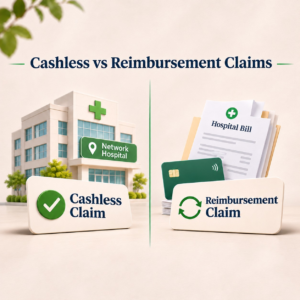
Cashless hospitalisation:
You are admitted at a network hospital → Hospital submits a pre-authorisation request → Insurer or TPA (Third Party Administrator) reviews and approves → You receive treatment → At discharge, hospital submits final bill → Insurer settles the eligible amount directly with the hospital
Under IRDAI’s Master Circular (2024), insurers are required to respond to cashless authorisation requests within 1 hour of receiving a complete request. Final discharge authorisation must be processed within 3 hours of the hospital’s request. These are regulatory mandates, not industry targets.
What cashless does not mean: Cashless settlement does not mean the full bill is paid. Policy limits, exclusions, deductibles, co-payments, room-rent overruns, and sub-limits still apply at settlement. You may still have to pay out of pocket for items outside the policy’s scope.
Reimbursement claim:
You are treated at any hospital (network or otherwise) → Pay the bill yourself → Collect all documents → Submit claim to insurer within the specified timeframe → Insurer reviews and processes → Eligible amount is reimbursed to your account
Reimbursement claims require meticulous documentation: original discharge summary, itemised bills, prescriptions, diagnostic reports, and payment receipts. Missing documents are a common cause of delays and partial settlements.
Practical note: Cashless is generally more convenient and reduces out-of-pocket float. But the network limitation matters, if your preferred hospital is not in the insurer’s network, you are always on the reimbursement route. Check the hospital network before you buy, not at the point of admission.
How to Evaluate an Insurer’s Claim Experience
The claim settlement ratio (CSR) is the most cited metric in health insurance comparison, and also one of the least informative in isolation.
A high CSR tells you what percentage of claims were settled. It does not tell you what percentage of the claimed amount was actually paid, how long settlements took, how many partial settlements occurred, or how many claims were disputed.
What to look at instead, or alongside:
- Claims information as a whole picture. Look at claim settlement data alongside complaint data. An insurer with a high settlement ratio but disproportionate complaints may be settling a high volume of claims while creating friction on a subset that matters.
- Claims turnaround. How long does the insurer typically take to settle reimbursement claims? The IRDAI requires specific turnaround times; whether an insurer meets them consistently is worth investigating.
- Cashless hospital network. This is not about total hospital count, it is about whether your specific hospitals are in the network. A network with 10,000 hospitals across India is irrelevant if none of them are in your city or near your home.
- TPA vs in-house claims. Some insurers process claims through a TPA (Third Party Administrator); others handle claims in-house. Neither is inherently better, but understanding who you will be dealing with at claim time, and how to reach them, is useful before buying.
- Digital and servicing infrastructure. Can you file a claim online? Is there a 24/7 helpline? How is the escalation process structured? These matter when you are dealing with a hospitalisation under stress.
Check the Hospital Network Before You Buy

This step is non-negotiable, and it is frequently skipped.
Before finalising any health insurance policy, verify:
- Your preferred hospital (the one you would actually go to for planned procedures)
- The nearest emergency hospital from your home
- Hospitals in your city with strong ICU and specialist care
- Hospitals where you already have established doctors or specialists
- Whether the cashless facility is available at those hospitals, or only reimbursement
Do this by going directly to the insurer’s official hospital network search tool or calling the insurer to confirm. Hospital network listings can change. Confirm, do not assume.
Also check:
- Whether there are any conditions on cashless access at specific hospitals (some hospitals may be network-listed but have conditional cashless arrangements)
- Whether the network covers hospitals in cities where you travel frequently or where family members live
How to check: Use the insurer’s official network hospital locator, available on their website. For the most current status, call the insurer directly and confirm the specific hospital by name before buying.
Family Floater vs Individual Health Insurance
|
Factor |
Family Floater |
Individual Policies |
|
Sum insured |
Shared across all covered members |
Separate for each member |
|
Premium |
Often lower for the same total coverage amount |
Higher collectively |
|
Risk of pool depletion |
One member’s hospitalisation can exhaust the shared pool |
One person’s claim doesn’t affect another’s cover |
|
Adding parents |
Usually increases premium sharply; often unsuitable |
Separate senior citizen policy often more practical |
|
Best suited to |
Young families with low concurrent hospitalisation risk |
Anyone with higher individual risk or when pool depletion is a concern |
There is no universal answer. The right structure depends on who needs cover, their ages, their health profiles, and what a worst-case scenario would look like for the family financially. A floater that gets exhausted by one member’s hospitalisation and leaves others unprotected mid-year is not the bargain it appeared to be at purchase.
Base Health Insurance + Super Top-Up: What You Need to Understand
The combination of a base policy and a super top-up has become a widely discussed way to build meaningful health cover at a manageable combined premium.
How it works:
- Base policy, covers hospitalisation up to its sum insured (say ₹10 lakh). You use this for claims up to that amount.
- Super top-up, activates once total hospitalisation expenses in a policy year exceed the deductible (say ₹10 lakh), and covers the amount beyond it, up to the top-up’s sum insured (say ₹50 lakh).
So in a year where total hospitalisation bills are ₹30 lakh:
- Base policy pays up to ₹10 lakh
- Super top-up covers the ₹20 lakh beyond the deductible
What it is not: A super top-up is not the same as simply increasing your base cover to ₹60 lakh. The claim mechanics differ. The deductible structure matters. If your total claims in a year don’t cross the deductible, the super top-up doesn’t pay anything.
The practical implication: The base policy and super top-up must be evaluated as a combined structure. The deductible amount should ideally match your base policy’s sum insured. And the insurers, waiting periods, and exclusions of both policies need to be understood together, the base policy gap doesn’t automatically carry over to the top-up.
A Policy Features Checklist
Before finalising any policy, run through this list:
|
Feature |
What to check |
|
Lifetime renewability |
Is the policy guaranteed renewable for life? |
|
Restoration benefit |
If the sum insured is exhausted in a year, does it restore automatically for further claims? |
|
No-Claim Bonus (NCB) |
Does the sum insured increase or premium reduce in claim-free years? What is the structure? |
|
Room-rent limit |
Is there a cap? What is proportionate deduction if the limit is exceeded? |
|
Co-payment |
Percentage, and when it applies |
|
Deductible |
Per-claim or aggregate, and the amount |
|
Sub-limits |
Are any specific procedures or conditions sub-limited? |
|
Consumables |
Are items like gloves, syringes and PPE covered or excluded? |
|
Pre/post-hospitalisation |
How many days on each side? |
|
Day-care procedures |
Are all standard day-care procedures listed and covered? |
|
Maternity |
Waiting period, what is covered, what the limits are |
|
OPD |
Is it included? As part of the base policy or as an add-on? |
|
Ambulance |
Covered? Up to what limit? |
|
AYUSH |
Covered? Under what conditions? |
|
Domiciliary treatment |
Covered? Under what conditions? |
|
Network hospitals |
Are your specific hospitals in the network? |
How to Actually Compare Two Health Insurance Policies
Do not compare brochures. Compare policy wordings.
Here is what a real side-by-side evaluation looks like, using 2 illustrative plans at a similar price point for a 35-year-old individual in a metro city:
|
Factor |
Plan A (₹14,500/year) |
Plan B (₹16,200/year) |
|
Sum insured |
₹10 lakh |
₹10 lakh |
|
Room-rent limit |
₹4,000/day (with proportionate deduction on associated charges) |
No room-rent limit |
|
PED waiting period |
3 years |
2 years |
|
Specific disease waiting period |
2 years for listed conditions |
1 year for listed conditions |
|
Co-payment |
20% on day-care procedures |
None |
|
Deductible |
None |
None |
|
Sub-limits |
Cataract: ₹35,000 |
No sub-limits |
|
Network hospitals (city) |
420 hospitals |
310 hospitals |
|
Restoration benefit |
100% once per year |
100% unlimited times per year |
|
No-Claim Bonus |
10% per year, up to 50% |
25% per year, up to 100% |
|
Pre/post-hospitalisation |
30 / 60 days |
60 / 90 days |
|
Cashless claim process |
TPA-managed |
In-house claims team |
|
Key exclusions |
OPD, dental, consumables |
OPD, dental |
|
Lifetime renewability |
Yes |
Yes |
What this comparison actually tells you:
Plan A is cheaper by ₹1,700/year. But it carries a room-rent cap with proportionate deduction on the full bill, a 20% co-pay on day-care, a cataract sub-limit of ₹35,000, and a longer PED waiting period. In a single hospitalisation where you choose a room above ₹4,000/day, the proportionate deduction alone can easily exceed the annual premium saving.
Plan B costs more upfront. But no room-rent limit, no co-pay, no sub-limits, and unlimited restoration mean the ₹10 lakh coverage is significantly more likely to actually pay like ₹10 lakh at claim time.
The cheapest policy on Day 1 is not always the cheapest policy at claim time. The difference between what a policy promises and what it actually pays is almost always explained by the terms in that comparison, not the sum insured number on the brochure.
Always run this comparison using the policy’s Key Information Sheet (CIS) and full policy wording, not the summary table on a comparison website, which shows what insurers choose to highlight.
5 Steps to Take Before Buying Health Insurance
- Determine who needs coverage. Individual, couple, family with children, parents separately, the coverage structure follows the people, not the other way around.
- Decide on an appropriate sum insured. Factor in your city, hospital costs, your existing medical history, and whether you are relying on this as your only coverage or as a supplement to employer cover.
- Shortlist policies based on coverage, not premium. Identify plans that match your hospital network requirements, don’t have co-pay clauses you are uncomfortable with, and have no room-rent limits (or limits you can live with).
- Compare exclusions, waiting periods and cost-sharing clauses. This step takes time. Do it anyway, the policy wording on these elements determines what you will receive at claim time.
- Verify hospitals, read the CIS, and confirm the claim process before signing. Ask the insurer how to file a cashless claim at your preferred hospital. Know the number to call. Understand the documentation you would need.
FAQs
How do I choose health insurance in India?
Compare policies on sum insured, hospital network, room-rent limits, PED waiting period, specific disease waiting periods, co-payment, deductibles, sub-limits, and exclusions. Do not compare on premium alone. A policy that costs slightly more but has no room-rent limit and no co-pay may protect you significantly better than a cheaper plan with restrictive clauses.
How much health insurance coverage should I buy?
For most urban families today, ₹10–15 lakh per individual is a practical starting point, with higher amounts warranted for metro cities or households with higher healthcare risk. The number should reflect actual hospitalisation costs in your city, not a generalised guideline. Employer cover should not be counted as your primary protection, it ends when the job does.
What should I check before buying health insurance?
Sum insured, hospital network, room-rent limits, PED waiting period, specific disease waiting periods, co-payment, deductibles, sub-limits, exclusions, restoration benefit, claim process, and the insurer’s grievance mechanism. Read the policy wording, not just the brochure.
What is a waiting period in health insurance?
A waiting period is the interval after policy inception during which a specific condition or category of treatment is not covered. Standard types include an initial waiting period (often 30 days, except accidents), PED waiting period, specific disease waiting period, and maternity waiting period. The specific duration and conditions vary by policy.
What is a pre-existing disease waiting period?
A PED (pre-existing disease) is a condition you had before the policy start date. Under IRDAI’s (Insurance Products) Regulations, 2024 (effective April 1, 2024), the maximum PED waiting period any insurer can apply is 3 years. Individual insurers may offer shorter periods. PED waiting periods mean that if you are admitted for a condition you had before buying the policy, the claim may not be admissible until the waiting period is complete, which makes disclosing existing conditions accurately at the time of purchase essential.
What are common health insurance exclusions?
Cosmetic and aesthetic procedures, non-medical expenses, routine dental treatment, spectacles and hearing aids, substance-abuse-related conditions, experimental treatments, OPD (unless covered), and conditions not disclosed at the time of purchase. Exclusions differ between policies, always check the specific exclusions of the plan you are evaluating.
What is a room-rent limit in health insurance?
A room-rent limit is the maximum daily room charge the policy will cover. If you choose a room above that limit, many policies apply a proportionate deduction to the entire hospital bill, not just the room cost. This can significantly reduce the admissible claim even when the total bill is within the sum insured. Policies without room-rent limits avoid this risk.
What is co-payment in health insurance?
Co-payment means you bear a defined percentage of every admissible claim. If your policy has a 20% co-pay and your admissible claim is ₹4 lakh, you pay ₹80,000 and the insurer pays ₹3.2 lakh. Co-pay clauses are common in senior citizen policies and policies for specific cities or hospital types.
What is the difference between a deductible and co-payment?
A co-payment is a percentage of every claim you must pay. A deductible is a fixed amount that must be exceeded before the insurer pays anything. With a co-pay, you share every claim. With a deductible, claims below the threshold are borne entirely by you; claims above it are covered by the insurer (less the deductible). They are distinct and can appear together in the same policy.
Is a family floater better than individual health insurance?
Not universally. A floater shares the sum insured across all members, one hospitalisation can deplete the pool for the year. For young families with low concurrent hospitalisation risk, floaters can be cost-effective. For families including senior citizens or members with existing conditions, separate policies are often more appropriate. Including parents in a floater is usually not recommended.
What is the difference between cashless and reimbursement claims?
In cashless claims (at network hospitals), the insurer settles eligible amounts directly with the hospital. In reimbursement claims, you pay the hospital first and the insurer reimburses the eligible amount after you submit documents. Cashless reduces your out-of-pocket float but requires the hospital to be in the insurer’s network. IRDAI mandates that cashless authorisation must be processed within 1 hour, and discharge authorisation within 3 hours.
How can I reduce the chances of a health insurance claim rejection?
Disclose all existing medical conditions accurately at the time of purchase. Understand the exclusions and waiting periods in your policy before you need to claim. Use network hospitals for cashless treatment. Submit complete documentation. Notify the insurer within the required timeframe. And, critically, read the policy wording before buying, not after a claim is filed.
Conclusion
The right health insurance policy is not the cheapest one. It is not the one with the highest advertised sum insured. It is the policy whose coverage, exclusions, waiting periods, cost-sharing clauses, hospital network and claims process actually match your healthcare needs.
Health insurance bought without understanding room-rent limits, co-pay, PED waiting periods and exclusions is a policy that may disappoint you at the moment it matters most.
Read the policy wording. Compare on the terms that determine your actual settlement, not the premium. And build your own independent cover early, before employer cover becomes the ceiling.
Need Help Understanding Your Insurance Options?
If you are looking at how health insurance fits alongside your broader financial planning, Snazzy Wealth can help you think through the right questions.
This article is for educational and general information purposes only. It is not insurance advice or a recommendation of any specific health insurance product. Insurance terms, conditions, exclusions and regulatory rules are subject to change, always refer to the current policy wording and IRDAI’s official guidance before making decisions. Snazzy Wealth Private Limited (ARN-259333) is an AMFI-registered Mutual Fund Distributor. Explore insurance-related support available through Snazzy Wealth’s registered partners.