
The RBI’s repo rate hike to 5.5% does not automatically make fixed deposits or debt mutual funds the better choice. FDs offer predetermined returns and capital certainty. Debt mutual funds offer market-linked returns, greater liquidity, and the ability to manage duration, along with different levels of interest-rate and credit risk. The better choice depends on your investment horizon, tax situation, liquidity needs, and risk tolerance. So, there is no universal answer.
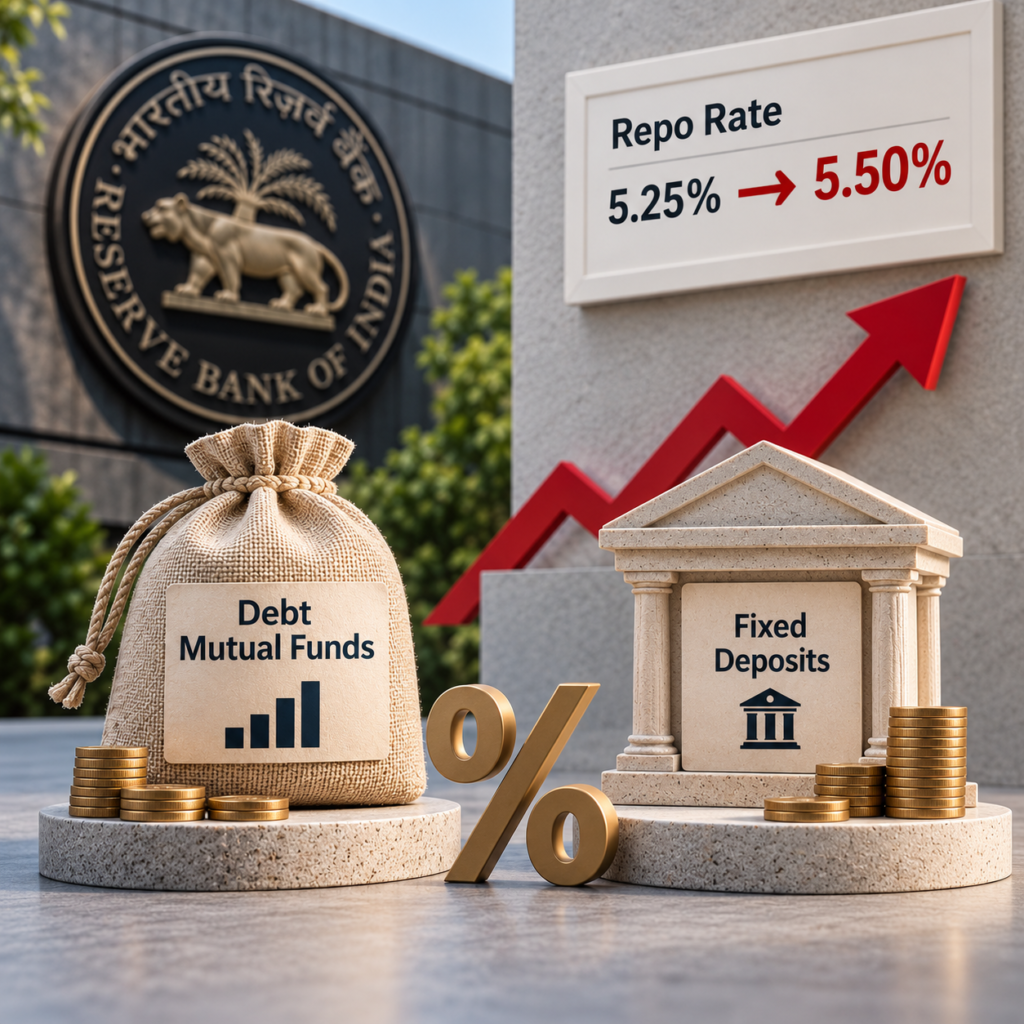
RBI Repo Rate Hike at 5.5%: Why Does It Matter for Fixed-Income Investors?
The repo rate is the rate at which the RBI lends money to commercial banks. When the RBI raises it, borrowing becomes more expensive for banks, which generally pushes up lending rates, and, over time, can push up deposit rates too.
For fixed-income investors, the October 7 hike from 5.25% to 5.50% matters because it changes the yield environment. Higher yields affect bond prices (and therefore debt fund NAVs) while simultaneously making new fixed deposits and bonds more attractive.
The key mechanics:
When yields rise, existing bonds paying lower coupons become less valuable. Their prices fall to compensate, which is why debt fund NAVs can decline in the short term after a rate hike. The longer the maturity of the bonds a fund holds, the more sensitive it is to this movement.
FDs are different. If you have already booked an FD, the rate you agreed to is locked in for the tenure. A later rate hike does not change your existing FD. New deposits may be repriced by banks, but there is no obligation on banks to pass on the full repo rate increase to depositors, and the timing varies across institutions.
Does a repo rate hike automatically increase FD interest rates?
Not immediately, and not necessarily by the same amount. Banks reprice deposit rates based on their own funding requirements, competition for deposits, and the overall interest rate environment. Some banks move quickly; others wait. The spread between repo rate and bank deposit rates is not fixed.
Debt Mutual Funds vs FDs: What’s the Difference?
| Factor | Debt Mutual Funds | Fixed Deposits |
| Return | Market-linked | Predetermined |
| Capital value | Can fluctuate | Principal generally fixed |
| Interest-rate risk | Yes, varies by duration | Generally lower for an already-booked FD |
| Credit risk | Depends on portfolio composition | Depends on bank or issuer |
| Liquidity | Generally high, subject to exit loads | Premature withdrawal may involve a penalty |
| Tenure | Flexible | Fixed tenure |
| Taxation | Depends on purchase date and holding period (see Section 8) | Interest taxed at applicable slab rate |
| NAV fluctuation | Yes, daily | None |
| Investment choice | Multiple categories with different risk profiles | Bank-selected rates and tenures |
| Suitable for | Investors accepting market-linked debt exposure | Investors prioritising predictability and simplicity |
The most important thing this table does not show: Debt mutual funds are not a single asset class. A liquid fund and a long-duration gilt fund are both “debt mutual funds”, but their risk profiles are entirely different. Any comparison that treats debt funds as homogeneous is incomplete.
How Does an RBI Rate Hike Affect Debt Mutual Funds?
Bond prices and interest rates
The relationship is inverse and fixed:
Rates ↑ → bond yields ↑ → existing bond prices ↓ → debt fund NAVs can fall
This is not a flaw or a loss of money in the conventional sense. If the fund holds a bond to maturity, it receives the full principal. But in the short term, the NAV reflects the fall in market value of the bonds it holds.
Duration matters
Duration measures how sensitive a fund’s price is to interest rate changes. A fund with an average duration of 5 years will lose approximately 5% in NAV for every 1% rise in yield. A fund with a duration of 6 months will lose approximately 0.5% for the same move.
Short-duration funds (average maturity under 3 years) are relatively more insulated in a rising-rate environment. The NAV impact is limited, and the fund can reinvest maturing bonds at the new, higher yields sooner.
Medium-duration funds (average maturity 3–7 years) carry moderate sensitivity. There is more NAV volatility in the short term, but if rates stabilise or fall, these funds benefit more than short-duration funds.
Long-duration and gilt funds are the most sensitive. A 25 bps hike has a proportionally larger impact on a 10-year fund than on a 1-year fund. These are not the right instruments for investors worried about near-term NAV stability.
Credit quality matters
Beyond duration, the quality of the bonds in a fund’s portfolio matters, especially in a rising-rate environment.
High-quality bonds (AAA-rated government securities, PSU bonds, AAA corporate bonds) are more liquid and carry lower default risk. Their prices fall when yields rise, but this is purely interest-rate risk, not credit risk.

Lower-rated or high-yield bonds offer higher interest income but carry credit risk, the risk that the issuer may default or be downgraded. In a tightening monetary environment, companies under financial stress face higher borrowing costs, which can increase credit risk.
Credit-risk funds specifically target lower-rated bonds for higher yield. In a rate-hike cycle, chasing yield through credit risk deserves more scrutiny, not necessarily avoidance, but clear-eyed evaluation.
A debt mutual fund is not a single product. Choosing one requires understanding both its duration profile and its credit quality, not just its category label.
Check out our blog to learn how RBI rate hike affects mutual fund investors for more insights.
How Does the RBI Rate Hike Affect Fixed Deposits?
Existing FDs
If you booked an FD before October 7, the rate is locked. A 25 bps RBI hike does not change your agreed rate. You will earn what was promised when you booked, for the tenure you agreed to. This is the capital certainty that FDs provide.
New FDs
Banks may revise their deposit rates in response to the repo rate hike, but not always immediately, and not always by the same quantum. Some banks have already revised rates upward in anticipation. Others may wait. If you are considering a new FD, compare rates across banks at the time of booking rather than assuming a particular spread over repo rate.
FD renewal
If your FD is maturing soon, the rate you receive on renewal may be different from your current rate. Whether it is higher or lower depends on what rates are prevailing at the time of renewal, not at the time your original deposit was booked.
Should you wait for higher FD rates before investing?
This is effectively a rate-timing decision. If you wait and rates rise further, you benefit. If you wait and rates plateau or the RBI pauses, you earn nothing in the interim while waiting. Consider what is available now, what you can actually earn while you wait (a liquid fund or a shorter-tenure FD), and whether the incremental rate gain, if any, justifies the delay relative to your goal timeline.
Debt Mutual Funds vs FDs: Which Is Better After a Rate Hike?
Neither is universally better. The rate hike changes the risk-return environment, it does not determine the right choice for every investor.
Consider an FD if you prioritise:
- Predictable returns and a known maturity value
- Capital stability, you cannot tolerate NAV fluctuation
- Simplicity, you want a clear, uncomplicated fixed-income instrument
- A specific maturity you need to plan around
- Lower risk tolerance for market-linked outcomes
Consider debt mutual funds if you prioritise:
- Liquidity without a fixed penalty structure
- The ability to manage duration and adjust your portfolio as rates evolve
- Diversification across multiple bonds and issuers
- The potential to benefit from bond price appreciation if the rate cycle peaks and reverses
- A goal horizon that aligns with a fund’s duration profile
A rate hike does not make debt funds bad or FDs good. It shifts the risk-return calculus, and the right answer depends on what you are optimising for.
Still confused? Get in touch with us at Snazzy Wealth to know more.
Debt Mutual Fund vs FD: What About Returns?
This comparison requires care. Returns from debt mutual funds are not guaranteed, they depend on portfolio yield, bond price movements, duration, credit outcomes, and when you invest relative to the interest rate cycle.
A mechanical comparison for ₹10 lakh invested for 2 years:
FD scenario:
- You lock in a rate, say, 7% per annum, at the time of booking.
- You know exactly what you will receive at maturity: approximately ₹11,44,900 before tax.
- That amount does not change if the RBI hikes or cuts rates during your tenure.
- Tax is deducted at source and your net return depends on your tax slab.
Debt mutual fund scenario:
- There is no predetermined return. The fund’s NAV moves daily based on the yield and price of the bonds it holds.
- If you invest in a short-duration fund after the rate hike, you may benefit from reinvestment at the new, higher yields as bonds in the portfolio mature and are replaced.
- If you invest in a longer-duration fund and rates rise further, you may experience further NAV decline before returns recover.
- The total return over 2 years will be the combination of the income earned and the NAV movement, which cannot be known in advance.
The correct takeaway is not that one option will produce a higher number. It is that FDs offer return certainty and debt funds offer return variability, sometimes to your advantage, sometimes not. The mechanism is different, not the outcome guaranteed in either direction.
FD vs Debt Mutual Fund: Taxation
Tax rules cited here are applicable as of October 2026. Tax laws are subject to change, verify current rates and treatment with a qualified tax professional before making decisions.
FD taxation
FD interest is treated as income from other sources and taxed at your applicable income tax slab rate. This applies whether the interest is paid out or reinvested (cumulative FDs still accumulate taxable interest each year as it accrues).
TDS is deducted by the bank at 10% (with PAN) if interest exceeds ₹40,000 in a financial year (₹50,000 for senior citizens). TDS is not your final tax liability, it is advance tax. If your actual tax liability is higher, you pay the difference; if lower, you claim a refund.
Form 15G (for those below 60) and Form 15H (for senior citizens) can be submitted to avoid TDS if your income is below the taxable limit.
Debt mutual fund taxation
Tax treatment depends on when you purchased the units:
Units purchased before 1 April 2023: Gains on units held for more than 24 months are classified as long-term capital gains (LTCG), taxed at 12.5% without indexation. Gains on units held for 24 months or less are short-term, taxed at your applicable slab rate.
Units purchased on or after 1 April 2023: All gains are treated as short-term and taxed at your applicable slab rate, regardless of how long you hold them. This change, introduced under Section 50AA, removed the LTCG benefit for funds with up to 35% domestic equity exposure.
IDCW (dividend) option: Dividend distributions are taxed as income at your slab rate. TDS at 10% applies on dividends above ₹5,000 per fund house per year.
The practical implication: For investors in higher tax brackets who purchased units after April 1, 2023, the tax treatment of debt funds is now similar to FDs, both taxed at slab rate. The distinction that used to favour longer-held debt funds no longer applies for recent purchases.
Check out our blog on Mutual Fund Taxation in India for related insights.
Which Is Better for Different Investment Horizons?
| Investment horizon | What to consider |
| Under 1 year | Capital stability and liquidity should dominate. Liquid funds or short-tenure FDs are the natural comparison. |
| 1–3 years | Compare short-duration debt fund yields against FD rates for the same tenure, factoring in your tax slab and liquidity needs. |
| 3–5 years | Duration, yield, tax treatment, and liquidity all become meaningful variables. The gap between debt fund flexibility and FD certainty is most relevant here. |
| 5 years and beyond | Pure FD vs. debt fund comparisons become less central, asset allocation across equity and debt based on your goal becomes the more important question. |
| Emergency fund | Capital stability and immediate access are non-negotiable. Liquid funds and savings-rate FDs are the relevant tools. |
| Regular income requirement | Compare FD interest income against a Systematic Withdrawal Plan (SWP) from a debt fund carefully, the mechanics, liquidity, and tax treatment differ significantly. |
Do not choose a fund category solely from a number of years. The horizon is one input, your risk tolerance, tax situation, and liquidity needs shape the rest.
FD vs Debt Mutual Funds for Different Types of Investors
Conservative investor
If predictable returns and capital stability are the priority, an FD is likely more appropriate. The certainty of a predetermined return removes the anxiety of watching NAVs fluctuate. Debt funds can work for conservative investors too, but only in shorter-duration, higher-quality categories where the NAV risk is limited.
Tax-conscious investor
Compare post-tax returns, not headline rates. An FD at 7.5% taxed at 30% slab yields a post-tax return of 5.25%. A debt fund earning a similar 7.5% yield and also taxed at 30% (for units bought after April 2023) yields a similar post-tax return, but with NAV variability and no guaranteed maturity value. The tax math no longer automatically favours debt funds for recent investors.
Investor with a short-term goal
Capital preservation and liquidity should govern the choice. Shorter-duration debt funds and short-tenure FDs are both reasonable, with the FD providing more certainty if you know exactly when you need the money.
Investor with a medium-term horizon (2–4 years)
This is where the comparison becomes nuanced. A short-to-medium duration debt fund in a rising-rate environment can offer reasonable returns as the portfolio reinvests at higher yields, with liquidity that an FD does not match. But if rates rise further before stabilising, NAV may dip first. The FD alternative offers certainty but no participation in the yield improvement.
Experienced investor
Debt funds allow active duration management, the ability to shift from longer to shorter duration funds as the rate cycle evolves, or to extend duration when the cycle peaks. This flexibility has real value for an investor who understands and monitors it. For those who do not, it is a source of unintended risk.
Retiree
The comparison here involves FD interest income, debt fund SWP, and the longevity of the corpus. FD interest gives a predictable monthly or quarterly payout. An SWP from a debt fund provides similar structure but with NAV variability. For retirees who need complete income predictability and cannot absorb NAV swings, FDs may be more appropriate. For those with some flexibility, debt funds with SWPs allow the corpus to remain market-linked, which can help manage purchasing power over a long retirement.
Read our article on Systematic Withdrawal Plans for retirees to know more.
Should You Move Existing Debt Mutual Funds Into FDs After the RBI Hike?
Not necessarily. Before making any switch, evaluate:
- Current debt-fund duration: If your fund’s average maturity is short and matches your horizon, a switch may not be necessary even in a rising-rate environment.
- Portfolio credit quality: Higher-quality holdings with limited credit risk may hold up fine through the rate cycle.
- Unrealised gains or losses: If the fund’s NAV has already fallen due to the rate hike, switching now may crystallise a loss.
- Tax implications: For units purchased after April 2023, any gains are taxed at slab rate regardless of the holding period. Check whether switching now creates unnecessary tax liability.
- Exit loads: Check whether your fund charges an exit load for the relevant holding period before switching.
- FD rates actually available: Do not assume that switching gives you the highest possible FD rate. Compare what specific banks are currently offering for your preferred tenure.
- Liquidity requirements: Once you book an FD, early withdrawal typically involves a penalty. If you may need the funds before the FD matures, the lost flexibility has a real cost.
A switch from debt funds to FDs is sometimes the right call. But the prompt to switch should come from a careful evaluation of these factors, not from a rate-hike headline.
What Should Investors Do After the RBI Rate Hike?
- Do not chase the highest FD rate blindly Compare rates across banks and check the issuer’s credit quality, tenure, and any conditions around premature withdrawal.
- Check the duration of your debt funds If you hold longer-duration funds and are uncomfortable with NAV volatility in a rising-rate environment, review whether that duration is still appropriate for your horizon.
- Compare post-tax returns Headline rates on FDs and fund yields are not directly comparable. Apply your tax slab to both and compare the net outcomes.
- Match the product to your goal A long-duration fund is not appropriate for a goal 12 months away, however attractive its past returns may look. Conversely, a 6-month FD is not a sensible vehicle for a 10-year goal.
- Diversify rather than make an all-or-nothing switch There is no rule that says your fixed-income allocation must be entirely in FDs or entirely in debt funds. A combination, shorter-duration funds for liquidity, FDs for capital certainty on a specific near-term goal, can make sense depending on your circumstances.
FD vs Debt Mutual Funds: Quick Decision Matrix
| If your priority is… | Consider |
| Guaranteed / predetermined return | FD |
| Capital predictability | FD |
| Simple fixed-income investing | FD |
| Known maturity value | FD |
| Market-linked debt exposure | Debt mutual fund |
| Portfolio diversification across bonds | Debt mutual fund |
| Duration management flexibility | Debt mutual fund |
| Potential benefit from falling yields later in the cycle | Debt mutual fund |
| Immediate emergency savings | Liquid fund or savings-linked FD, liquidity first |
| Tax efficiency | Compare your individual post-tax outcome, neither is automatically better |
| Retirement income | Compare FD interest vs SWP carefully across liquidity, tax, and corpus longevity |
“Consider” is the right word throughout. These are factors to weigh, not categorical recommendations.
Conclusion
There is no universal winner between FDs and debt mutual funds after the RBI’s 5.5% repo rate hike.
FDs offer what they have always offered: certainty, simplicity, and a predetermined maturity value. That does not change with a rate hike, it is precisely what makes them valuable to investors who need it. Debt mutual funds offer what they have always offered: flexibility, diversification across bonds, and market-linked returns that can work in your favour or against you depending on how the rate cycle evolves.
The right question is not which one is better after this hike. The right question is which one fits your goal, your horizon, your tax situation, and your tolerance for NAV variability. That answer is individual, and it does not change because of a single policy decision.
If you are unsure whether your current fixed-income allocation is appropriate for your goals, consider reviewing your portfolio with an AMFI-registered mutual fund distributor.
FAQs
Is FD better than debt mutual funds after an RBI rate hike?
Neither is universally better. A rate hike makes the environment more complex for both. FDs become more attractive to those who value certainty, but only on new deposits, and only when banks actually reprice. Debt funds face short-term NAV pressure but can benefit from higher reinvestment yields over time. The better choice depends on your horizon, risk tolerance, and tax situation.
Are debt mutual funds affected when RBI increases the repo rate?
Yes. Rising repo rates push up bond yields, which causes existing bond prices to fall. Debt funds holding those bonds see NAV declines. The magnitude depends on the duration of the fund, longer-duration funds are more affected than shorter-duration ones.
Will FD interest rates increase after the RBI repo rate hike?
They may. Banks can reprice deposit rates in response to a repo rate hike, but they are not obligated to do so immediately or to pass on the full increase. Timing and quantum vary by bank and by market conditions.
Should I invest in FD or debt mutual funds now?
It depends on your goal, horizon, and risk tolerance, not on the rate environment alone. For capital certainty and simplicity, FDs are more appropriate. For flexibility, liquidity, and the ability to manage duration, debt mutual funds offer different tools. There is no single right answer for every investor.
Which is safer, FD or debt mutual fund?
“Safer” depends on what risk you are measuring. FDs from scheduled commercial banks carry deposit insurance up to ₹5 lakh per depositor per bank. Debt mutual funds carry market risk (NAV fluctuation) and credit risk (depending on the portfolio). FDs eliminate market risk on the principal; debt funds do not. However, high-quality short-duration debt funds have historically been relatively stable, not risk-free, but not as volatile as equity.
Can debt mutual funds give better returns than FDs?
Sometimes, and depending on the rate cycle and fund category, but not guaranteed. A short-duration fund reinvesting at higher yields after a rate hike may outperform an FD booked before rates rose. A long-duration fund that suffers NAV declines from further hikes may underperform the same FD. Returns from debt funds are not predictable in the way FD returns are.
What happens to existing FDs when RBI increases rates?
Nothing changes on your existing FD. The rate you booked is locked for the agreed tenure. Only new deposits and renewals are subject to the rates prevailing at the time of booking.
What happens to debt mutual fund NAV when interest rates rise?
NAVs generally fall in the short term. Bond prices move inversely to yields, as yields rise, existing bond prices fall, pulling down the fund’s NAV. The extent of the fall depends on the fund’s duration. This effect reverses as the portfolio matures and reinvests at the new, higher yields.
Are short-duration debt funds better when interest rates rise?
They are less affected, yes. Shorter-duration funds hold bonds with nearer maturities. Their NAVs are less sensitive to yield movements. They also reinvest maturing bonds at the new, higher yields sooner, which can improve future returns. They are not immune to rate moves but are more insulated than longer-duration alternatives.
Should I switch from debt mutual funds to FD after an RBI rate hike?
Not automatically. Before switching, evaluate your fund’s duration and credit quality, any unrealised gains or losses, the tax consequence of the switch, exit loads, and whether the FD rates actually available today justify the loss of flexibility. A switch can make sense for specific goals or risk profiles, but should follow a considered evaluation, not a reaction to the headline.
This article is for educational and general information purposes only. It is not investment, financial, legal, or tax advice. Mutual fund investments are subject to market risks. Past performance is not indicative of future results. Please read all scheme-related documents carefully before investing. Tax rules cited are applicable as of October 2026 and are subject to change, verify current rates and treatment with a qualified tax professional before making any decisions. FD interest rates are indicative and vary by bank and tenure. Deposit insurance is subject to applicable DICGC limits and terms. Snazzy Wealth Private Limited (ARN-259333) is an AMFI-registered Mutual Fund Distributor.