
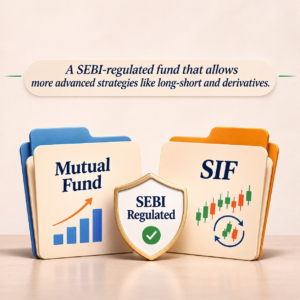
A Specialised Investment Fund (SIF) is a SEBI-regulated investment category that sits within the mutual fund framework but allows fund managers to use strategies not available in conventional mutual funds, including long-short positions and more flexible use of derivatives. With a ₹10 lakh minimum investment threshold for most investors, SIFs are positioned between traditional mutual funds and higher-ticket products like PMS and AIFs.
The practical gap SIFs fill:
- Conventional mutual funds – accessible to all investors, well-diversified, but constrained in strategy flexibility and generally long-only
- SIF – pooled fund structure like a mutual fund, but with more specialised strategies including long-short and derivative-based approaches; ₹10 lakh minimum
- PMS – individually managed portfolio, ₹50 lakh minimum
- AIF – pooled fund for sophisticated investors, ₹1 crore minimum
This is a simplified positioning. It does not mean SIF is automatically lower risk than every PMS or AIF, strategy risk varies enormously within each category.
What Does SIF Stand For?
SIF stands for Specialised Investment Fund.
SEBI introduced the SIF framework through a circular dated February 27, 2025, with the category becoming effective April 1, 2025. SIFs operate under the mutual fund regulatory framework, meaning they are SEBI-regulated, managed by an AMC, and priced through NAV, but are permitted to use investment strategies that conventional mutual fund categories cannot.
Why Did SEBI Introduce Specialised Investment Funds?
The honest answer is that there was a structural gap in India’s investment product landscape.
Conventional mutual funds, by design, have standardised investment mandates. SEBI’s mutual fund categorisation is fairly prescriptive about what each fund type can and cannot do. This is good for most investors because it creates consistency and comparability. But it also means that sophisticated strategies, long-short equity, derivative-based positioning, more concentrated sector bets, were simply not available within the mutual fund structure.
The alternative products that did allow these strategies required significantly higher minimums:
- PMS: ₹50 lakh minimum
- Category III AIF: ₹1 crore minimum
SIF is designed to make more sophisticated strategies available at a lower entry point (₹10 lakh), while keeping the investor within the familiar, regulated mutual fund framework.
Whether the product category achieves this in practice depends on the specific strategy and fund manager, but that is the structural rationale.
Who Can Invest in a SIF?
Minimum investment: ₹10 lakh
The ₹10 lakh minimum applies at the PAN level, aggregated across all SIF strategies offered by the same AMC. This is a meaningful distinction.
It does not mean you need ₹10 lakh for each strategy you invest in. It means your total investment across all SIF strategies from a single AMC must add up to at least ₹10 lakh. SEBI clarified this explicitly in April 2025.
You can invest via SIP, SWP or STP, but the aggregate across the AMC’s SIF strategies must stay above ₹10 lakh. The AMC monitors the minimum investment threshold. If an investor-initiated transaction causes the aggregate investment to fall below ₹10 lakh, the units may be frozen for debit and the investor given 30 calendar days to rebalance. If the investor does not restore compliance within that period, the frozen units are automatically redeemed. A decline caused solely by market movements is treated differently from an active breach.
Accredited investors are exempt from the ₹10 lakh minimum investment requirement. They can invest below the threshold.
On AMC eligibility: Not every AMC can launch a SIF. SEBI requires the AMC to either have operated for at least 3 years with an average AUM of ₹10,000 crore or more over the preceding 3 years, or meet an alternate route requirement: appointing a CIO with at least 10 years of fund management experience (managing ₹5,000 crore average AUM) alongside an additional fund manager with at least 3 years of experience.
Exploring Specialised Investment Funds?
Who Should, and Who Probably Should Not, Consider a SIF?
SIF may be worth evaluating for investors who:
- Already have a diversified core portfolio
- Can commit ₹10 lakh and have liquidity beyond it
- Understand how derivatives work and what long-short strategies involve
- Want to explore strategies beyond conventional mutual fund categories
- Understand that strategy complexity can introduce risks not present in standard funds
SIF is probably not suitable for:
- First-time investors building an initial portfolio
- Investors who do not understand derivatives or short-selling
- Anyone who needs short-term access to the invested capital
- Investors choosing a SIF primarily because “25% short exposure sounds defensive”, that number is a regulatory ceiling, not a guaranteed cushion
How Does a SIF Work?
The structure is straightforward even if the strategies are not:
| Step | What happens |
| You invest | ₹10 lakh minimum at PAN level across all SIF strategies from that AMC |
| AMC pools the money | Your capital is combined with other investors’ money into a single fund, just like a mutual fund |
| Fund manager runs the strategy | The designated manager executes the SIF’s specific approach, equity long-short, hybrid, or debt long-short, within SEBI’s permitted limits |
| Assets deployed | Equities, debt instruments, and derivatives, depending on the strategy type |
| You receive NAV-based returns | Performance is reflected daily in the fund’s NAV, same as any mutual fund |
This is a pooled fund structure, which is an important distinction from PMS, where your portfolio is managed individually with your specific securities. In a SIF, your money is pooled with other investors’ money and managed as a single fund, with NAV declared as in any mutual fund.
What Investment Strategies Can SIFs Use?
SEBI’s framework permits 7 strategy types across 3 categories. Every strategy in the SIF framework allows up to 25% of net assets in unhedged short exposure through derivatives, that is the regulatory ceiling across all strategies.
Equity strategies
- Equity Long-Short Fund Minimum 80% in equities across market caps, with no sector or market-cap constraint. Open-ended or interval structure, with daily minimum redemption frequency.
- Equity Ex-Top 100 Long-Short Fund Minimum 65% in stocks outside the top 100 companies by market capitalisation, meaning mid and small caps. The mandate is specifically designed for managers who believe smaller-cap stocks offer alpha that large-cap indices do not capture. Open-ended or interval, daily minimum redemption.
- Sector Rotation Long-Short Fund Minimum 80% across up to 4 sectors. The 25% short exposure limit applies at the sector level. This is for managers who want to express active views on sector-level positioning. Open-ended or interval, daily minimum redemption.
Hybrid strategies
- Active Asset Allocator Long-Short Fund No fixed floor for any single asset class, the manager can move freely across equity, debt, derivatives, foreign securities, REITs/InvITs, and commodities. The 25% short limit applies to equity and debt derivative positions combined. Interval structure, minimum redemption twice weekly.
- Hybrid Long-Short Fund At least 25% in equity and at least 25% in debt at all times. Interval structure only, minimum redemption twice weekly.
Debt strategies
- Debt Long-Short Fund Long positions in bonds across durations, with short positions taken through exchange-traded debt derivatives. Interval structure, minimum weekly redemption.
- Sectoral Debt Long-Short Fund Invests in at least 2 debt sectors, with no more than 75% in a single sector. Interval structure, minimum weekly redemption.
An important note on debt SIFs: As of June 2026, no pure debt-oriented SIF strategies are actually live in the market. The active SIF universe is concentrated in equity and hybrid strategies, particularly hybrid long-short and active asset allocator approaches.
What Is Long-Short Investing in a SIF?
Long position: The fund buys a security or takes a position that benefits when the price rises. Standard for all mutual funds.
Short position: The fund takes a position (typically through derivatives) that can benefit when the price of the underlying declines. This is what conventional mutual funds generally cannot do, and what SIFs, within limits, can.
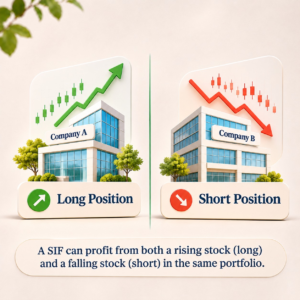
A simple example: A fund manager believes Company A is undervalued and likely to rise, and that Company B is overvalued and likely to fall.
- A conventional mutual fund can buy Company A. It can also avoid Company B by not holding it. But it cannot directly profit if Company B falls.
- A long-short SIF can buy Company A (long) and take a derivative position on Company B that benefits if Company B declines (short). Both views can be expressed in the same portfolio.
What the 25% short limit actually means: The 25% unhedged short exposure is a regulatory ceiling, the maximum any SIF strategy can hold in unhedged short positions. It is not a floor, not a target, and not a guaranteed defensive buffer.
A fund manager may choose to use 5% short exposure, or 15%, or 0% at any given time. Whether and how much short exposure is actually being used is a strategy decision. Before investing in any SIF, check how the manager actually uses derivatives and short positions, not just what the regulatory ceiling allows.
SIF vs Mutual Fund: Key Differences
| Factor | Mutual Fund | SIF |
| Minimum investment | Low (as low as ₹500 for SIP) | ₹10 lakh at PAN level per AMC |
| Regulation | SEBI | SEBI |
| Structure | Pooled | Pooled |
| Pricing | NAV-based | NAV-based |
| Strategy flexibility | Prescribed by SEBI category | More specialised; long-short permitted |
| Long-short strategies | Generally not available | Permitted within framework |
| Unhedged short exposure | No | Up to 25% of net assets |
| Derivative use | Primarily hedging and rebalancing | More strategic flexibility |
| Investor profile | Broad retail and HNI | Sophisticated investors with higher ticket size |
| Strategy complexity | Usually lower | Moderate to high |
| Liquidity | Scheme-dependent; often daily | Strategy-dependent; some are interval-only |
The article should not say “SIF is riskier than every mutual fund.” What is accurate:
SIF strategies can involve greater complexity and potentially higher risk than conventional mutual funds because they can use short positions, derivatives, and more concentrated strategies. But risk varies by specific strategy and fund manager.
To understand the conventional mutual fund structure better, you can also read our guide on how direct growth mutual funds work.
SIF vs PMS vs AIF: Where Does It Fit?
| Factor | Mutual Fund | SIF | PMS | AIF (Cat III) |
| Structure | Pooled | Pooled | Individual portfolio | Pooled |
| Minimum investment | Low | ₹10 lakh | ₹50 lakh | ₹1 crore |
| Customisation | Low | Strategy-level | High (individual) | Strategy-level |
| Short/derivative strategies | Limited | More flexible | Strategy-dependent | Category-dependent |
| Regulation | SEBI | SEBI | SEBI | SEBI |
| Investor involvement | Low | Low–moderate | Higher | Moderate |
| Strategy complexity | Low–moderate | Moderate–high | High | High |
| Suitable for | Broad investors | Sophisticated investors | HNIs wanting customisation | HNIs/institutional investors |
Do not read this as a risk ladder. AIF, PMS and SIF strategies vary enormously within each category. A conservative PMS with a large-cap, low-turnover mandate may carry less risk than an aggressive equity long-short SIF. The minimum investment is not a proxy for risk level.
Investors evaluating this segment should also understand how Portfolio Management Services work, particularly the difference between individually managed portfolios and pooled investment structures.
For a more detailed comparison of these investment categories, read about the difference between AIFs and mutual funds.
What Are the Risks of Investing in SIFs?
Most investor content on SIFs lists risks in one line. This section gives you what you actually need to evaluate them.
- Derivative risk Derivatives can magnify the impact of market movements on the portfolio, beyond what the underlying security movement would imply. They also introduce basis risk (the derivative price diverges from the underlying), rollover risk (cost and execution when contracts expire), and model risk (the manager’s assumptions about market behaviour may be wrong).
- Short-selling risk A short position profits when the underlying falls, but if the underlying rises instead, the loss on the short can be significant. Unlike a long position (which can only fall to zero), a short position faces theoretically unlimited upside risk on the security being shorted.
- Strategy risk Two SIFs in the same broad category, for example, both classified as Equity Long-Short, can be managed with completely different approaches and behave very differently. Category label alone tells you little about how the fund will actually behave. The fund manager’s specific strategy, sector views, and derivative approach matter far more than the category name.
- Concentration risk Some SIF strategies allow positions that are more concentrated than conventional mutual fund norms within applicable limits. A focused bet that works is valuable; a focused bet that goes wrong has more impact than a diversified fund.
- Liquidity risk Not all SIF strategies allow daily redemption. Hybrid and debt strategies are structured as interval funds, meaning redemption happens on specific dates, not daily. If you need liquidity, you may not be able to exit when you want to.
- Track record risk SIF is a new category. Most SIF strategies have been live since 2025. Very limited performance history exists across full market cycles, meaning you cannot evaluate how these funds have handled a sustained bear market, a sudden spike in volatility, or a sharp sector-level dislocation.
- Cost risk More active strategies tend to involve higher transaction costs, derivative rolling costs, and potentially higher total expense ratios. These costs reduce net returns.
- Tax and regulatory risk Tax treatment of SIF investments depends on the scheme’s equity/debt composition and prevailing tax rules, and these can change. Do not assume a uniform tax treatment across all SIF strategies. Check the scheme’s characteristics and the latest applicable tax rules before investing.
Are SIFs Safer Than Mutual Funds?
Not necessarily.
SEBI regulation means the fund operates within a regulated framework, it does not eliminate investment risk or guarantee any particular outcome.
The argument for SIFs being “safer” usually goes: short positions can cushion a portfolio when markets fall. That may be true in specific scenarios, but:
- Short positions can also lose money if the market moves against them
- An incorrect short position adds losses on top of losses in a falling market
- Derivative strategies introduce risks that standard long-only funds do not carry
A SIF can be more sophisticated than a conventional mutual fund. Sophisticated and safer are not the same thing.
What Are the Potential Benefits of SIFs?
This section is intentionally balanced.
What SIFs genuinely offer:
- Access to long-short and derivative strategies within a regulated, pooled structure
- A lower minimum ticket than PMS or AIF for similar strategy types
- NAV-based pricing and the established mutual fund framework
- Professional fund management within SEBI’s oversight
- Potential to diversify a portfolio beyond conventional long-only strategies
What SIFs do not guarantee:
- Higher returns than conventional mutual funds
- Lower risk or reduced drawdowns
- Superior alpha from the long-short structure, this depends entirely on the fund manager’s skill in implementing the strategy
There is no basis for a blanket claim that SIFs deliver higher returns with lower risk. Performance depends on strategy execution, market conditions and the specific fund.
How to Evaluate a SIF Before Investing
If you are seriously considering a SIF, here is what actually matters:
- Understand the specific strategy What is this particular fund actually trying to do? How does the manager express long and short views? What is the investment thesis?
- Check whether derivatives are actually being used, and how Is the short exposure being used for hedging? For directional bets? For portfolio construction? Or is it primarily a marketing differentiator? The regulatory ceiling of 25% short exposure tells you what is permitted, the fund’s actual portfolio tells you what is happening.
- Understand concentration levels How large are individual positions? How many securities is the fund holding? A concentrated fund with high conviction bets and a diversified fund with moderate views on many positions behave very differently.
- Look at drawdowns, not just returns Maximum drawdown and drawdown recovery time tell you more about how the fund behaves in difficult markets than CAGR alone. For a new category with limited history, examine how the manager has managed similar strategies in earlier roles.
- Check liquidity carefully When exactly can you redeem? What is the minimum redemption frequency? Does this match your actual liquidity needs?
- Understand all costs Total Expense Ratio plus any derivative rolling costs and transaction-related charges. Net-of-cost returns are what matter.
- Read the ISID The Investment Strategy Information Document (ISID) is the SIF equivalent of a scheme information document. It describes the fund’s strategy, risk factors, and investment approach in regulatory disclosure language. Reading it is not optional.
- Check whether it complements your existing portfolio A SIF should add something to your existing portfolio, a strategy dimension that your current funds do not cover. If the SIF is duplicating what you already own or introducing risk you do not need, it is not adding value regardless of how the category is positioned.
SIF Taxation
SIFs fall within the mutual fund framework, which means tax treatment follows the same broad principles as mutual fund taxation, but the specific tax outcome depends on the scheme’s underlying portfolio composition.
An equity-oriented SIF (minimum 65% in equity-related instruments, as defined under applicable tax rules) is treated as an equity fund for tax purposes. A non-equity-oriented SIF is treated differently.
However, derivative-heavy strategies can affect how a scheme’s equity/debt orientation is computed for tax purposes, and the rules themselves are subject to change.
What this means in practice: Do not assume a uniform tax treatment across all SIF strategies. Before investing, check the specific scheme’s equity/debt orientation and verify the applicable tax rules as of the investment date. SEBI and AMFI documentation, along with the scheme’s offer documents, are the right reference points, not generalised comparisons with conventional mutual funds.
SIF vs Mutual Fund vs PMS: Which Is Better?
There is no universal answer. The right product depends on what the investor actually needs.
A conventional mutual fund makes more sense if:
- You are building your core portfolio
- You want simplicity, standardised categories, and daily liquidity
- You do not understand derivatives and do not want to
- You are investing below ₹10 lakh or cannot tie up that amount
- You want a product with a long, verifiable track record across multiple market cycles
A SIF may be worth evaluating if:
- You already have a diversified core portfolio in conventional mutual funds
- You have ₹10 lakh+ available that you can commit without needing short-term access
- You understand what long-short strategies involve
- You specifically want exposure to strategies that conventional funds cannot offer
- You are comfortable evaluating a newer category with limited historical data
PMS may be more appropriate if:
- You want your portfolio individually managed for your specific situation
- You meet the ₹50 lakh minimum
- You want a more personalised portfolio structure with direct security-level visibility
How Is the SIF Market Growing in India?
SIF is new, and growth has been rapid.
SIFs have expanded rapidly since the category became operational in 2025. According to AMFI’s October 2026 Monthly Note, total SIF assets under management reached approximately ₹42,670 crore, up 11.4% from September. Hybrid investment strategies accounted for ₹29,930 crore, while equity-oriented strategies accounted for ₹12,740 crore. No debt-oriented SIF AUM was reported for the month.
These figures indicate that hybrid strategies currently represent the largest part of the SIF market. However, growth in AUM should not be interpreted as evidence of superior investment performance or suitability.
FAQs
What is a Specialised Investment Fund (SIF)?
A Specialised Investment Fund is a SEBI-regulated investment category within the mutual fund framework that allows fund managers to use more sophisticated strategies than conventional mutual funds, including long-short positions and derivative-based approaches. The minimum investment is ₹10 lakh for most investors.
What does SIF stand for?
SIF stands for Specialised Investment Fund. SEBI introduced the framework in February 2025, effective April 1, 2025.
Who can invest in a SIF?
Any investor who meets the ₹10 lakh minimum investment threshold at the PAN level for a given AMC’s SIF strategies. Accredited investors are exempt from this minimum.
What is the minimum investment in a SIF?
₹10 lakh, aggregated at the PAN level across all SIF strategies offered by the same AMC. This is not a per-strategy or per-scheme requirement, it is a combined threshold across that AMC’s SIF offerings.
Is the ₹10 lakh minimum per scheme?
No. SEBI clarified in April 2025 that the ₹10 lakh minimum is at the PAN level across all SIF investment strategies offered by a single AMC, not per strategy or per scheme.
Can SIFs take short positions?
Yes. SIFs are permitted to hold unhedged short exposure of up to 25% of net assets through derivatives. This is a regulatory ceiling, not a floor or target. The actual short exposure used at any given time depends on the fund manager’s strategy decisions.
Can SIFs invest in derivatives?
Yes. All 7 permitted SIF strategy types can use derivatives, with the 25% unhedged short exposure cap. Derivative use can include hedging, directional bets, and portfolio construction, the purpose and approach vary by strategy.
What are the risks of investing in SIFs?
Derivative risk, short-selling risk, strategy risk (two funds in the same category can behave very differently), concentration risk, liquidity risk (some strategies are interval-only), limited track record risk, cost risk, and tax/regulatory risk. None of these is a reason to automatically avoid SIFs, but all of them need to be understood before investing.
What is the difference between SIF and mutual funds?
SIFs operate within the mutual fund framework (NAV-based, pooled, SEBI-regulated) but allow long-short and derivative strategies that conventional mutual fund categories cannot use. The minimum investment is ₹10 lakh for SIFs vs as low as ₹500/month for a standard mutual fund SIP.
What is the difference between SIF and PMS?
SIF is a pooled fund structure, your money is combined with other investors’ money and managed as a single portfolio. PMS involves individually managed portfolios, you own the specific securities directly. PMS minimum is ₹50 lakh vs SIF’s ₹10 lakh. Both offer sophisticated strategies but through different structural arrangements.
Are SIFs safer than mutual funds?
Not necessarily. SEBI regulation governs the framework but does not eliminate investment risk. Short positions and derivative strategies can reduce losses in some scenarios but create losses in others. SIFs can be more sophisticated, but sophisticated and safer are not the same thing.
How should I evaluate a SIF before investing?
Understand the specific strategy in detail, check how derivatives are actually being used (not just what is permitted), review drawdowns rather than only returns, verify redemption frequency and liquidity, read the ISID (Investment Strategy Information Document), and ensure the SIF is adding something to your existing portfolio rather than duplicating what you already hold.
Who can distribute SIF products?
SIF distribution is subject to separate eligibility and certification requirements. NISM introduced the Series V-D certification for Mutual Fund and Specialized Investment Fund distributors in July 2026. Investors should verify the distributor’s current eligibility and registration before proceeding with a SIF transaction.
Conclusion
The SIF category addresses a genuine structural gap: investors who want strategies beyond conventional mutual funds but cannot access PMS (₹50 lakh) or AIFs (₹1 crore) now have a regulated, pooled option at ₹10 lakh.
But the ₹10 lakh minimum and the word “specialised” should both be taken seriously. These are not straightforward products to evaluate. The strategy complexity is real, the track records are short, and the risk profile can be meaningfully different from a standard equity mutual fund.
If you are building a core portfolio, conventional mutual funds remain the right starting point. If you already have a diversified core and are specifically looking to add a long-short or derivative-based dimension, and you understand what that involves, SIFs are worth evaluating on their merits.
If you are looking at how SIFs might fit alongside your existing mutual fund portfolio, Snazzy Wealth can help you think through the right questions.
This article is for educational and general information purposes only. It is not investment advice or a recommendation of any specific SIF product. SIF is a relatively new SEBI-regulated category, regulatory frameworks, tax treatment and industry data are subject to change. Always refer to current SEBI circulars, scheme offer documents and applicable tax rules before making investment decisions. Snazzy Wealth Private Limited (ARN-259333) is an AMFI-registered Mutual Fund Distributor and is not a SEBI-registered Investment Adviser.